
Introduction
This report examines how economic sanctions developed in 2025 across five allied Western jurisdictions: the United Kingdom, the European Union, the United States, Australia, and Canada and what these developments signalled for 2026. The selected jurisdictions account for the four jurisdictions in which the Global Sanctions Coalition (GSC) operates alongside the United States, the world’s leading economic sanctions power.
While existing reports approach sanctions in 2025 from a compliance perspective, GSC assesses financial sanctions as a policy tool, examining their impact, efficacy, and even the harms caused by sanctions, whether intentionally or indiscriminately. Part I of the report examines consequential sanctions targets in 2025: Russia, Iran, Venezuela, Sudan, Myanmar, and Israel. For each sanctions designation target area, the report examines how different jurisdictions used sanctions, the impact and efficacy of sanctions, and how jurisdictions’ goals or aspirations for sanctions may have aligned or diverged.
Part II explores two emerging thematic areas in 2025: a) the use of economic sanctions in furtherance of states’ foreign policy, including the defense of human rights, with a look towards States’ potential legal obligations to implement sanctions to prevent atrocities; and b) the abuse of sanctions to impede accountability for violations of international law, with a focus on U.S. sanctions related to the International Criminal Court. The report concludes with analysis of emerging trends and an emerging fault line in 2025, with analysis for the new year.
Methodology
Global Sanctions Coalition works with data published directly by each jurisdiction. For the European Union, GSC relies on the EU’s own reported figures for total relevant designations under applicable sanctions regimes. The UK and Canada provide a searchable database of designations online with designation dates, which permits searching and tallying total applicable designations. Similarly, Australia’s Department of Foreign Affairs and Trade (DFAT) publishes designation data in an excel sheet from which GSC isolated relevant sanctions regimes and their application in 2025. The United States Treasury’s central repository of sanctions designations does not include designation dates, and external online repositories of U.S. sanctions do not accurately capture all designations. 1. U.S. Department of the Treasury Banner, Sanctions List Search, https://sanctionssearch.ofac.treas.gov. For this report, Global Sanctions Coalition focused on Treasury designations and tallied total designations directly from relevant OFAC announcements, following established practice.
It should be noted that there is variability across these jurisdictions and in how they categorize their economic sanctions regulations. For example, the United Kingdom categorized Russia-related cyber designations under its main Russia sanctions regime, whereas the United States issued related cyber designations under the Countering America’s Adversaries Through Sanctions Act [“CAATSA”] and a separate more general cybercrime regime. The EU published Russian and Belarus vessel designations together, making it difficult to identify vessels sanctioned under the Russia regime alone. To the extent possible, GSC exercised discretion to select comparable sanctions categories and data, but alternate approaches may yield different figures. The potential variability is highest for Russia-Ukraine and Iran related sanctions, given the high rates of sanctions designations and multitude of available sanctions regimes (especially for the United States). The reliance upon total designation figures is itself an imperfect index that does not capture the variance in scale of different designations. Sanctioning an individual or small foreign company may be a quite modest measure compared to a major initiative, like the UK and US sanctions on Russian oil companies Lukoil and Rosneft. Given this potential variability in total numbers and in what these numbers signify, this report focuses on qualitative trends over quantitative analysis.
Part I: Countries in Focus — Key Global Developments in 2025
1. Russia-Ukraine Related Sanctions
| Sanctions Category (2025) | UK | EU | US | AUS | CAN |
|---|---|---|---|---|---|
| Russia-Ukraine Designations | 743 | 794 | 620 | 407 | 660 |
A simple comparison of total sanctions designations under Western governments’ relevant Russia-Ukraine sanction regimes over the course of 2025 would indicate Russia’s invasion of Ukraine remains a shared priority for Europe, the UK, the U.S., Canada, and Australia. Yet this comparison fails to tell the full story, as these numbers conceal a major shift in the U.S. approach to Russia’s war on Ukraine.
Over 2025, the EU and United Kingdom led the world in Russia-Ukraine related designations with 794 and 743 new designations, respectively. 2. This figure includes 510 vessel designations (designations included in US and UK tallies), but the EU categorizes Russia and Belarus tallies together, meaning some of the vessel sanctions may be technically categorized as Belarus sanctions rather than directly as Russia-Ukraine sanctions. EU sanction designated vessels, December 18, 2025, https://www.dma.dk/growth-and-framework-conditions/maritime-sanctions/sanctions-against-russia-and-belarus/eu-vessel-designations. In addition, the EU-Ukraine sanctions figure does not include Russia designations unrelated to the war on Ukraine (RUSS & RUSDA) EU Sanctions Tracker, Ukraine, March 2026, https://data.europa.eu/apps/eusanctionstracker/search/WyJyZWdpbWUvVUtSIl0=. Furthermore, UK numbers include cybercrime designations not directly related to Russia-Ukraine. Search the UK Sanctions List, parameters: https://search-uk-sanctions-list.service.gov.uk/?searchValue=russia&dateFrom=1-1-2025&dateTo=31-12-2025&designationSources=UK®imeNames=Russia. Canada followed with 660 such designations. 3. Consolidated Canadian Autonomous Sanctions List, GAC, February 19, 2026, https://www.international.gc.ca/world-monde/international_relations-relations_internationales/sanctions/consolidated-consolide.aspx?lang=eng#sanctions-table. Sanctions may further be individually tallied here. Canadian Sanctions Related to Russia, GAC, February, 19, 2026, https://www.international.gc.ca/world-monde/international_relations-relations_internationales/sanctions/russia-russie.aspx?lang=eng. The United States, which had issued a record number of Russia-related sanctions in 2024, listed only 620 designations under its Russia-Ukraine designation framework. 4. This number is limited to Russia designations under Russia EO 14024 (and UKRAINE-EO13662, which overlap with EO 14024). Russia-related and Russia/Ukraine-related Designations; Venezuela-related Designations; Publication of Russia-related Determinations; Issuance of Russia-related General Licenses and Frequently Asked Questions, OFAC, January 10, 2025, https://ofac.treasury.gov/recent-actions/20250110; Russia-related Designations; Issuance of Russia-related and Russia-/Ukraine-related General Licenses; Implementation of the Federal Civil Penalties Inflation Adjustment Act, OFAC, January 15, 2025, https://ofac.treasury.gov/recent-actions/20250115; Russia-related Designations; Issuance of New and Amended Russia-related General Licenses, OFAC, October 22, 2025, https://ofac.treasury.gov/recent-actions/20251022. Australia issued 407 Russia-related designations (making approximately 95% of Australia’s new designations in 2025 Russia-related). 5. Australia and Sanctions, Consolidated List What is the Consolidated List?, https://www.dfat.gov.au/international-relations/security/sanctions/consolidated-list (To search, apply Russia related regulations & remove aliases).
One indication the United States has developed a new approach to Russia is the steep drop in total Russia-related designations through 2025, in comparison to the prior year. In 2024, OFAC imposed a record setting 1,700+ Russia-related designations — over twice its 2025 total. 6. ”2024 in Review A Year of Expanded Sanctions and Trade Controls and Increased Enforcement Actions”, K2 Integrity, February 2025, https://www.k2integrity.com/wp-content/uploads/2025/02/K2_-Sanctions-Year-in-Review_2024_A-FINAL.pdf This drop-off was not echoed by the other jurisdictions, who instead escalated their new Russia-related sanctions designations. 7. Australia prioritized targeting Russia’s ‘shadow’ fleet. See, “Australian sanctions: Navigating the waters of 2025 and charting the course for 2026 across the Asia Pacific”, Herbert Smith Freehills Kramer, February 12, 2026, https://www.hsfkramer.com/en_US/insights/2026-02/corporate-crime-360-your-complete-guide-to-apac-trends-in-2026/australian-sanctions-navigating-the-waters-of-2025-and-charting-the-course-for-2026.
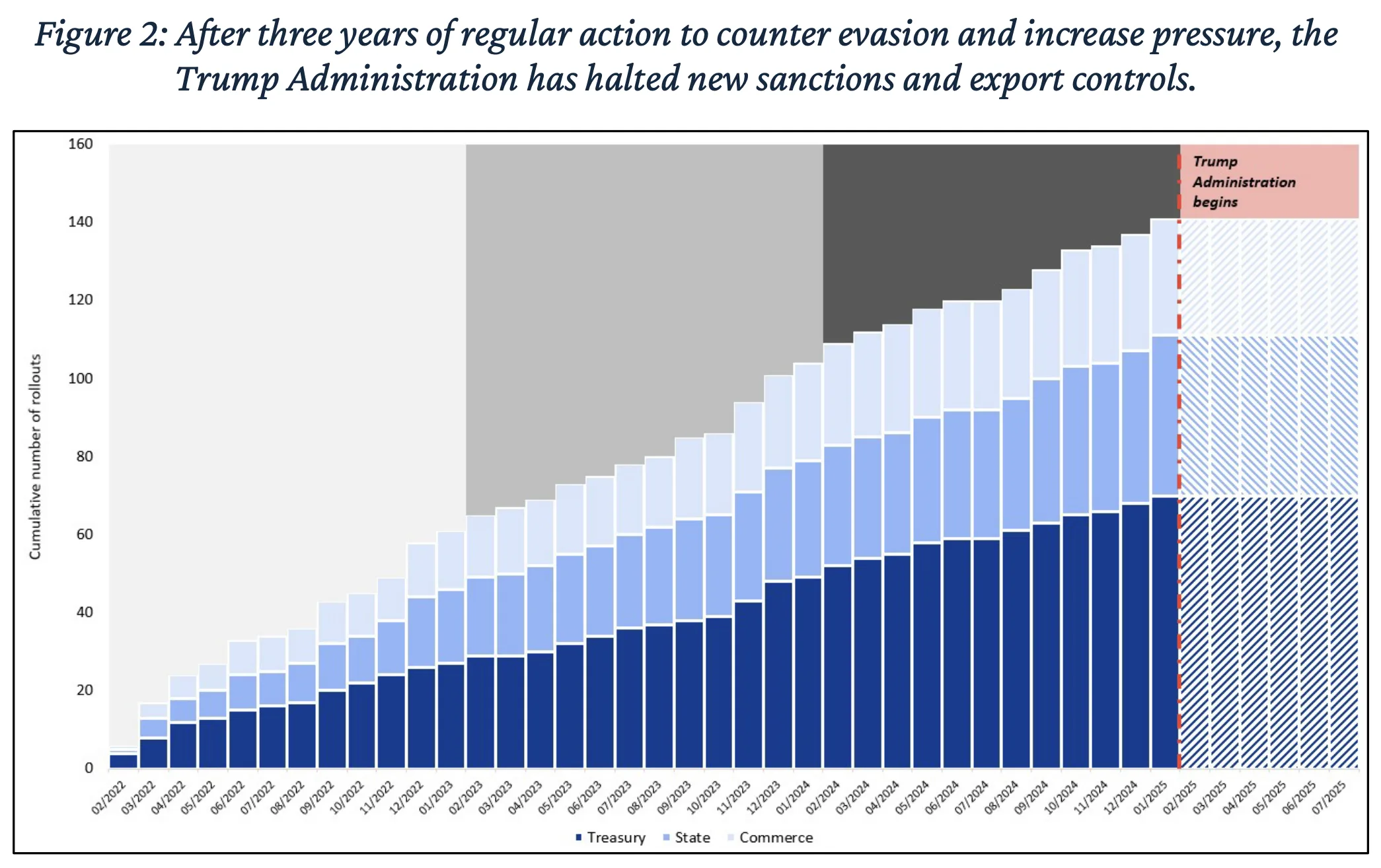
The contrast grows more stark through a month-by-month analysis of sanctions designations. Canada, Australia, the UK, and the EU consistently rebuked Russia via additional designations, a pattern in line with these countries’ multilateral, escalatory approach towards Russia in previous years. 8. Ibid. On the other hand, U.S. Treasury’s Russia-related sanctions slammed to a halt after President Trump took office on January 20, 2025. 9. As did designations by the U.S. Department of State and Commerce. Both images from “Dropping the Baton: How America is Failing to Use Russia Sanctions and Export Controls to Help Achieve a Just Peace in Ukraine”, Minority Staff Report for Senator Warren & Senator Shaheen, August 2025, https://www.banking.senate.gov/imo/media/doc/final_dropping_the_baton_-how_america_is_failing_to_use_russia_sanctions_and_export_controls_to_help_achieve_a_just_peace_in_ukraine-_august_2025.pdf. Nearly 95% of the United States’ Russia-related designations in 2025 — 584 of 620 total designations — occurred during the final ten days of the Biden administration. 10. ”Russia-related and Russia-/Ukraine-related Designations; Venezuela-related Designations,” Publication of Russia-related Determinations; Issuance of Russia-related General Licenses and Frequently Asked Questions, OFAC, January 10, 2025, https://ofac.treasury.gov/recent-actions/20250110 (416 EO-14024 designations); Russia-related Designations; Issuance of Russia-related and Russia-/Ukraine-related General Licenses; Implementation of the Federal Civil Penalties Inflation Adjustment Act”, OFAC, January 15, 2025, https://ofac.treasury.gov/recent-actions/20250115 (340 EO-14024 designations). And the United States did not make a single designation under its core Russia-related sanctions regulations from January 16 through October 21, 2025. 11. The United States did make cybercrime related designations not directly related to Russian aggression in Ukraine during this period. Cyber-related Designations; CAATSA - Russia-related Designations; Russia-related Designation Update and Removal, OFAC, July 1, 2025, https://ofac.treasury.gov/recent-actions/20250701 (7); Counter Narcotics and Counter Terrorism Designations and Designation Updates; Cyber-related Designations, OFAC, August, 14, 2025, https://ofac.treasury.gov/recent-actions/20250814 (10).
Although the United States did not cease enforcement of Russia-related sanctions, the Trump administration acted swiftly to dissolve Task Force KleptoCapture, the unit enforcing sanctions on Russian oligarchs. 12. ”Total Elimination of Cartels and Transnational Criminal Organizations,” Office of the Attorney General, February 5, 2025, https://www.justice.gov/ag/media/1388546/dl. Meanwhile, the enforcement of Russia-related sanctions ramped up in other jurisdictions. The EU and UK both intensified enforcement of Russia-related sanctions in 2025, continuing a trend emerging in previous years. 13. ”EU sanctions enforcement is on the rise”, A&O Shearman, June 11, 2025, https://www.aoshearman.com/en/insights/eu-sanctions-enforcement-is-on-the-rise; “Countering Russian sanctions evasion: guidance for the freight and shipping sector”, Department for Business & Trade and Office of Trade Sanctions Implementation, November 3, 2025, https://www.gov.uk/government/publications/countering-sanctions-evasion-guidance-for-freight-and-shipping/countering-russian-sanctions-evasion-guidance-for-the-freight-and-shipping-sector. Canada launched its first ever criminal case under the Special Economic Measures Act (SEMA) in June 2025 for alleged violations of Russia-related sanctions regulations. 14. Tomiwa Babatunde, “Sanctions Compliance in 2025: Why Staying Ahead of Canada’s Expanding Regime Matters,” Ontario Bar Association, January 15, 2026, https://oba.org/sanctions-compliance-in-2025-why-staying-ahead-of-canada-s-expanding-regime-matters/. Australia remains relatively inactive in terms of sanctions enforcement, but this passivity is not unique to Russia sanctions. 15. ”Australian sanctions: Navigating the waters of 2025 and charting the course for 2026 across the Asia Pacific”, Herbert Smith Freehills Kramer, February 12, 2026, https://www.hsfkramer.com/en_US/insights/2026-02/corporate-crime-360-your-complete-guide-to-apac-trends-in-2026/australian-sanctions-navigating-the-waters-of-2025-and-charting-the-course-for-2026.
In August 2025, the Trump administration’s inaction in regards to Russia’s invasion of Ukraine drew scathing condemnation from a Congressional Minority Report. The report determined the Trump administration had failed to implement the sanctions maintenance required to impede Russian workarounds and that the administration’s explanations for the lull in Russia sanctions “did not stand up to scrutiny." 16. "[F]requent actions to counter evasion and keep the costs to Russia rising over time had not previously been provocative. Instead, they were necessary, and remain necessary, to maintain an effective program in response to blatant, ongoing aggression.” “Dropping the Baton: How America is Failing to Use Russia Sanctions and Export Controls to Help Achieve a Just Peace in Ukraine”, Minority Staff Report for Senator Warren & Senator Shaheen, August 2025, https://www.banking.senate.gov/imo/media/doc/final_dropping_the_baton_-how_america_is_failing_to_use_russia_sanctions_and_export_controls_to_help_achieve_a_just_peace_in_ukraine-_august_2025.pdf. The Trump administration’s explanation for the standstill varied. In June, the administration explained new sanctions could jeopardize a peace deal, a rather marked contrast to the administration’s “maximum pressure” strategy towards Iran. 17. By August, the Trump administration had issued 21 sanctions roll-outs towards Iran and subjected the country to a bombing campaign. Felicia Schwartz, “Europe wants Trump to sanction Russia. Rubio says not yet”, Politico, June 25, 2025, https://www.politico.com/news/2025/06/25/trump-rubio-sanctions-russia-nato-00422668; Aaron Krolic, “Lack of New U.S. Sanctions Allows Restricted Goods and Funds Into Russia”, New York Times, July 2, 2025, https://www.nytimes.com/2025/07/02/us/politics/trump-russia-sanctions.html; “Dropping the Baton: How America is Failing to Use Russia Sanctions and Export Controls to Help Achieve a Just Peace in Ukraine”, Minority Staff Report for Senator Warren & Senator Shaheen, August 2025, https://www.banking.senate.gov/imo/media/doc/final_dropping_the_baton_-how_america_is_failing_to_use_russia_sanctions_and_export_controls_to_help_achieve_a_just_peace_in_ukraine-_august_2025.pdf. When directly pressed about calls from Europe to apply more sanctions on Russia, Trump said: “Well, Europe is saying that, but they haven’t done it yet. Let’s see them do it first." 18. "Remarks: Donald Trump Holds a Bilat with Keir Starmer of the United Kingdom,” Roll Call, June 16, 2025, https://rollcall.com/factbase/trump/transcript/donald-trump-remarks-bilat-united-kingdom-keir-starmer-alberta-canada-june-16-2025/. The EU and UK had already issued Russia-related sanctions packages in February and May and issued a further package in July 2025. 19. ”Dropping the Baton: How America is Failing to Use Russia Sanctions and Export Controls to Help Achieve a Just Peace in Ukraine”, Minority Staff Report for Senator Warren & Senator Shaheen, August 2025, https://www.banking.senate.gov/imo/media/doc/final_dropping_the_baton_-how_america_is_failing_to_use_russia_sanctions_and_export_controls_to_help_achieve_a_just_peace_in_ukraine-_august_2025.pdf President Trump additionally noted his concern for the humanitarian impacts of sanctions on Russia’s economy and people, a concern the president has not generally expressed in other sanctions contexts. 20. ”And look, the Russian economy — I don’t want to do that to Russia. I love the Russian people. They’re great people. I don’t want to do that to Russia.” “Remarks: Donald Trump Holds a Bilat with Keir Starmer of the United Kingdom,” Roll Call, July 28, 2025, https://rollcall.com/factbase/trump/transcript/donald-trump-remarks-bilat-starmer-united-kingdom-july-28-2025/.
In late August 2025, the Trump administration did issue sizable Russian-oil tariffs on India but did not issue equivalent tariffs on China, Russia’s biggest oil customer. 21. Alex Kozul-Wright, “Why is the US sparing China, but not India, for importing Russian oil?,” Al Jazeera, August 20, 2025, https://www.aljazeera.com/news/2025/8/20/why-is-the-us-sparing-china-but-not-india-for-importing-russian-oil. India had already begun reducing their reliance on Russian oil over the first half of 2025 and diversifying their oil supply, suggesting the tariffs may have been superfluous. 22. Sharad Raghavan, “India’s shift away from Russian oil imports predates Trump tariffs”, November 20, 2025, https://www.thehindu.com/business/Economy/indias-shift-away-from-russian-oil-imports-predates-trump-tariffs/article70298792.ece; The tariffs did cause India to ramp up their Russian oil purchases before the tariffs would take effect. Vrinda Sahai, “The Impact of U.S. Sanctions and Tariffs on India’s Russian Oil Import,” Carnegie India, November 20, 2025, https://carnegieendowment.org/posts/2025/11/the-impact-of-us-sanctions-and-tariffs-on-indias-russian-oil-imports.
After a nine month sanctions pause, the Trump administration finally moved to expand Russia sanctions on October 22, 2025, designating major Russian oil companies Lukoil and Rosneft and their subsidiaries. 23. ”Russia-related Designations; Issuance of New and Amended Russia-related General Licenses”, OFAC, October 22, 2025, https://ofac.treasury.gov/recent-actions/20251022. The Trump administration additionally listed one further tranche of cyber designations alongside the UK and Australia in November. “Cyber-related Designations; CAATSA - Russia-related Designations; Issuance of Russia-related Frequently Asked Question”, OFAC, November 19, 2025, https://ofac.treasury.gov/recent-actions/20251119 (12); “United States, Australia, and United Kingdom Sanction Russian Cybercrime Infrastructure Supporting Ransomware”, U.S. Department of the Treasury, November 19, 2025, https://home.treasury.gov/news/press-releases/sb0319. These designations were imposed concurrently with the UK, alongside related EU sanctions on Lukoil subsidiaries and Rosneft, demonstrating an apparent realignment. 24. Hungary and Slovakia reportedly impeded full EU sanctions on Lukoil, limiting EU sanctions to Rosneft and Lukoil subsidiaries. Hungary was able to get an exemption for US Lukoil sanctions. Jorge LIboreiro, “EU and US impose new sanctions on Russia to force ceasefire in Ukraine”, October 22, 2025, https://www.euronews.com/my-europe/2025/10/22/eu-agrees-new-sanctions-on-russia-as-us-threatens-substantial-pickup-in-pressure; Paul Sampson, “EU Bypasses Blacklisting Lukoil Due to Internal Pushback”, Energy Intelligence, October 23, 2025, https://www.energyintel.com/0000019a-119d-d853-ab9f-5fff4cc20000. For the United States, the designations appeared to mark a significant escalation and a more hardline approach towards Russia’s war in Ukraine following the failure of the August 2025 summit in Alaska. 25. ”Treasury Sanctions Major Russian Oil Companies, Calls on Moscow to Immediately Agree to Ceasefire”, October 22, 2025, https://home.treasury.gov/news/press-releases/sb0290. By late November, however, the terms of Trump’s proffered Russia-Ukraine deal came to light, reinforcing critics’ views that the Trump administration was placating Russian demands. 26. Mark F. Cancian and Maria Snegovaya, “The Unfinished Plan for Peace in Ukraine: Provision by Provision”, CSIS, November 24, 2025, https://www.csis.org/analysis/unfinished-plan-peace-ukraine-provision-provision. A key concern of the allies was that the deal’s terms required significant territorial concessions by Ukraine, rewarding the Russian invasion and contradicting the international legal prohibition against annexation. 27. Ibid. This political fissure suggested that the coordinated Rosneft and Lukoil designations may have served very different geopolitical ambitions.
Sanctions Impact and Efficacy
Impact and efficacy are two different sanctions metrics. The impact of sanctions upon Russia may be measured in the direct economic consequences for Russia’s economy or changes in Russia’s ability to continue their war in Ukraine. Sanctions efficacy, on the other hand, depends on whether sanctions impacts are advancing the sanctioning jurisdictions’ goals. Over 2025, financial sanctions certainly bore a continued impact on Russia’s economy. The efficacy of these sanctions, however, was undermined by an apparent divergence in underlying goals.
Whatever the precise goals behind the Western allies’ coordinated designations in October, the escalation of sanctions targeting Russia’s oil sector sanctions has measurable economic effects. Russian oil prices declined after the expanded designations. 28. ”Russia’s oil revenues dwindle as sanctions bite, hitting economy”, AP, February 10, 2026, https://www.euronews.com/business/2026/02/10/russias-oil-revenues-dwindle-as-sanctions-bite-hitting-economy; “Russian Oil Prices Sink Below $35 Per Barrel”, The Moscow Times, December 19, 2025, https://www.themoscowtimes.com/2025/12/19/russian-oil-prices-sink-below-35-per-barrel-a91496. Given persistent global energy demand, however, Russian oil remained a valuable commodity in the international market over 2025. Russia has therefore continued to export oil to key partners. 29. Claire Mills, “Sanctions against Russia: Targeting third countries”, House of Commons Research Briefing, November 4, 2025, https://commonslibrary.parliament.uk/research-briefings/cbp-10048/. Even within the European Union, EU member state Hungary continued to purchase Russian oil under an exemption framework. 30. Ben Johansen and Diana Nerozzi, “Trump exempts Hungary from Russian oil sanctions for 1 year”, Politico, November 7, 2025, https://www.politico.com/news/2025/11/07/trump-opens-the-door-for-an-exemption-for-hungary-on-russian-oil-sanctions-00642146.
For 2026, a central question remains: what is driving each jurisdiction’s sanctions policy towards Russia. For the EU, the UK, Australia, and Canada, the answer is clear. They aim to protect the territorial integrity of Ukraine and uphold the fundamental prohibition against the use of force and annexation, especially when it imperils the rest of Europe. These jurisdictions have reiterated that ending Russia’s presence in Ukraine is not enough. Any acceptable resolution must also include accountability measures, including reparations for war damage and the return of kidnapped Ukrainian children. 31. ”Foreign Affairs Council: Press conference by High Representative Kaja Kallas,” February 23, 2026, https://www.eeas.europa.eu/eeas/foreign-affairs-council-press-conference-high-representative-kaja-kallas-2_en; Joint statement on Ukraine: 15 December 2025, Prime Minister’s Office, 10 Downing Street, December 15, 2025, https://www.gov.uk/government/news/joint-statement-on-ukraine-15-december-2025; “Joint declaration following the fourth Canada – European Union joint ministerial committee meeting,” Council of the European Union, November 12, 2025, https://www.consilium.europa.eu/en/press/press-releases/2025/11/12/eu-canada-joint-ministerial-committee-joint-declaration/; “We must stand with Ukraine in defending its future generations: UK statement at the UN General Assembly,” Foreign, Commonwealth & Development Office, December 5, 2025, https://www.gov.uk/government/speeches/we-must-stand-with-ukraine-in-defending-its-future-generations-uk-statement-at-the-un-general-assembly; Tom McIlroy, “Penny Wong says Ukraine’s territorial integrity must be upheld amid global backlash to Trump plan,” The Guardian, November 23, 2025, https://www.theguardian.com/world/2025/nov/24/trump-ukraine-peace-plan-penny-wong-australia-territorial-integrity.
Recent U.S. peace proposals led by the Trump Administration suggest a far greater willingness to placate Russian interests in order to end the war. This approach may reinforce Russian reluctance to make concessions. If U.S. sanctions are primarily aimed at ending the conflict at any cost, this puts Washington at odds with key allies. For the EU, the UK, Australia, and Canada, these sanctions are intended to uphold international law and accountability, not just stop the fighting. These diverging objectives undermine multilateral coordination. When partners are pursuing different ends, the overall effectiveness of multilateral sanctions is weakened.
The seismic impacts of the U.S.-Israeli war on Iran launched in February 2026 threaten to further upend Russia sanctions designations’ impact and efficacy. Already, Iran’s rather predictable closure of the Strait of Hormuz and the subsequent implosion of international oil markets drove the United States to temporarily relieve some Russian oil sanctions, leading commentators to deem Russia the “biggest winner” of the ongoing conflict in the Middle East. 32. Anastasia Stogne, Rachel Millard, Krishn Kaushik, and Andres Schipani, “Russia rakes in $150mn a day in extra revenue from surging oil prices”, March 12, 2026, https://www.ft.com/content/dd973148-b6a1-4096-97da-3090a058fe08; Alan Rappeport, “Trump Removes Sanctions on Russia to Help Oil Flow Amid Iran Conflict,” New York Times, March 12, 2026, https://www.nytimes.com/2026/03/12/us/politics/trump-russia-oil-sanctions.html.
2. Iran-Related Sanctions
| Sanctions Category (2025) | UK | EU | US | AUS | CAN |
|---|---|---|---|---|---|
| Iran | 79 | 248 | 870 | 0 | 11 |
Iran faced a drastic escalation in international sanctions pressure in 2025, although Western allies varied in how much they prioritized Iran relative to Russia. The United States led by a wide margin, issuing 870 Iran-related designations, far more than any of its key partners. 33. GSC’s figures for Treasury’s Iran designations are based on: designations under the twin Iran Executive Orders: IRAN-EO13902 and IRAN-EO13846; nuclear non-proliferation (NPWMD) and Special Designated Global Terrorist (SDGT) designations categorized as Iranian Financial Security Regulations (IFSR); SDGT designations explicitly described as Iran-linked (but not those categorized as related to Houthis, Hezbollah, other Iran-linked groups); Iran Conventional Arms related sanctions; and hostage sanctions under EO-14078 described as Iran-linked. See “Iran” “2025”, Recent Actions, OFAC, https://ofac.treasury.gov/recent-actions. The EU and UK followed with 248 and 79 designations, respectively. 34. See “Iran” “2025”, UK Sanctions List, Iran Regulations, https://search-uk-sanctions-list.service.gov.uk; EU Sanctions Tracker, Sanctioned individuals and entities, “Iran,” March 2026, https://data.europa.eu/apps/eusanctionstracker/search/WyJyZWdpbWUvSVJOIl0=. Canada issued 11 Iran-related designations, while Australia made none.
While Russia is cited as the “the most sanctioned country” globally by total sanctions designations, Iran remains subject to far more comprehensive U.S. sanctions. 35. Philip Luck, “How Sanctions Have Reshaped Russia’s Future, Center for Strategic & International Studies,” February 24, 2025, https://www.csis.org/analysis/how-sanctions-have-reshaped-russias-future. It is under a near-total U.S. embargo that covers all of Iran and all Iranian persons, measures broader in scope which carry significant civilian impacts. Multilateral pressure on Iran also intensified. Just prior to the expiration of the Joint Comprehensive Plan of Action (JCPOA) in October 2025, France, Germany, and the UK (the E3) triggered the JCPOA’s snapback sanctions mechanism, and UN sanctions on Iran were officially reimposed in September 2025. 36. ”UK reimposes UN sanctions on Iran, Foreign, Commonwealth & Development Office,” October 1, 2025, https://www.gov.uk/government/news/uk-reimposes-un-sanctions-on-iran; “Re-imposition of UN, UK and EU sanctions on Iran – 29 September 2025”, October 6, 2025, Dentons, https://www.dentons.com/en/insights/alerts/2025/october/6/reimposition-of-un-uk-and-eu-sanctions-on-iran.
However, UN-mandated sanctions differ from autonomous sanctions, which more directly reflect national policy priorities. In practice, the EU, UK, and their member states continued to prioritize Russia as the more immediate threat over Iran. Still, both the EU and the UK significantly increased total Iran-related designations and enforcement actions in 2025. 37. See e.g., “Italy has frozen Russian oligarchs assets worth more than $2.6 billion”, Maritime Reporter, June 23, 2025, https://www.marinelink.com/blogs/blog/italy-has-frozen-russian-oligarchs-assets-worth-more-than-26-102940 https://blogs.duanemorris.com/europeansanctionsenforcement/2025/06/30/italy-seizures-against-iranian-company-associated-with-russia/. Canada and Australia are still expanding their capacity for sanctions enforcement, but Australia did launch a criminal investigation into alleged transfers involving Iranian banks. 38. Holding Redlich, “Six things businesses need to know about Australia’s sanctions regime”, Lexology, https://www.lexology.com/library/detail.aspx?g=b4c9a5c0-1acd-4628-b7a9-382385c50714; Rita Trichur, “Canada struggles to enforce sanctions against countries including Russia and Iran, creating headaches for businesses”, The Global Mail, September 12, 2025, https://www.theglobeandmail.com/business/commentary/article-canada-struggles-enforce-sanctions-russia-iran-headaches-businesses/; Chapter 3 - “Strengthening the sanctions regime”, Parliament of Australia, https://www.aph.gov.au/Parliamentary_Business/Committees/Senate/Foreign_Affairs_Defence_and_Trade/Sanctions47/Report/Chapter_3_-_Strengthening_the_sanctions_regime.
For the United States, aggressive enforcement of Iran sanctions was a central priority in 2025. Under the Trump administration, the U.S. reasserted a “maximum pressure” approach described as a “robust and continual sanctions enforcement campaign” to deny “the regime and its terror proxies access to revenue.” 39. Clayton Thomas, “U.S. Sanctions on Iran,” Library of Congress, August 19, 2025, https://www.congress.gov/crs-product/IF12452; NATIONAL SECURITY PRESIDENTIAL MEMORANDUM/NSPM-2, The White house, February 4, 2025, https://www.whitehouse.gov/presidential-actions/2025/02/national-security-presidential-memorandum-nspm-2/; “Press Release: The Departments of Treasury and Justice Take Action Against Iranian Weapons Procurement Network”, U.S. Department of the Treasury, April 1, 2025, https://home.treasury.gov/news/press-releases/sb0066; “Iranian Company and Two Iranian Nationals Charged with Conspiring to Provide Material Support to Islamic Revolutionary Guard Corps (IRGC) and for Scheme to Procure U.S. Technology for Iranian Attack Drones”, Office of Public Affairs, April 1, 2025, https://www.justice.gov/opa/pr/iranian-company-and-two-iranian-nationals-charged-conspiring-provide-material-support. In the U.S. Treasury’s 2025 Year in Review, OFAC lauded its hardline posture, including what it described as the largest Iran-related sanctions package since 2018, with over 110 designations in a single action. 40. ”Secretary Bessent’s First Year: Making America Great Again”, U.S. Department of the Treasury, https://home.treasury.gov/2025/index.html. As part of this effort, the United States led global efforts to target Iran’s “shadow fleet” and “shadow banking” network. Sanctioning Iran’s “Shadow Banking” Network of Money Launderers and Illicit Oil Traders, U.S. Department of State, June 6, 2025, https://www.state.gov/releases/2025/06/sanctioning-irans-shadow-banking-network-of-money-launderers-and-illicit-oil-traders. As noted above, this approach stands in sharp contrast to the administration’s more conciliatory posture towards Russia.
This divergence extended beyond sanctions. In contrast to its Russia policy, the Trump administration coupled intensified financial pressure on Iran with direct military intervention in June 2025. During Israel and Iran’s 12-day war, the U.S. struck nuclear-related sites using bunker-buster munitions — an action UN experts characterized as an unlawful use of force. 41. ”UN experts condemn United States attack on Iran and demand permanent end to hostilities”, UN OHCHR, June 26, 2025, https://www.ohchr.org/en/press-releases/2025/06/un-experts-condemn-united-states-attack-iran-and-demand-permanent-end. This escalation marked the opening phase of what has since become a far more expansive U.S.–Israeli war against Iran in 2026.
Sanctions Impact and Efficacy
Economic sanctions have imposed significant hardship on Iran and its population. However, their effectiveness remains contested and, as with Russia, depends on the underlying objectives of the sanctioning states. If sanctions are assessed as tools of coercive diplomacy—intended to compel concessions or improve human rights outcomes—their record in Iran is limited. However, if they are understood as instruments that can generate pressure, instability, and escalation, they may be evaluated differently.
There is substantial evidence that decades of sanctions have, in some respects, strengthened hardline elements within Iran. 42. Babak RezaeeDaryakenari, Vahid Ghafouri, Nihat Kasap, “Who Rallies Round the Flag? The Impact of the US Sanctions on Iranians’ Attitude toward the Government,” Foreign Policy Analysis, January 2025, https://academic.oup.com/fpa/article/21/1/orae033/7913348; Hadi Kahalzadeh, “Maximum Pressure” Hardened Iran Against Compromise, Foreign Affairs, March 11, 2021, https://www.foreignaffairs.com/articles/iran/2021-03-11/maximum-pressure-hardened-iran-against-compromise. In 2025, sanctions did little to compel Iran to concede to U.S. demands or to improve the country’s human rights situation. At the same time, sustained economic pressure has contributed to internal strain and heightened tensions, dynamics that some policymakers may have viewed as advancing broader strategic objectives.
Iran has also adapted to prolonged sanctions pressure. It has deepened economic alignment with Russia and China, building channels that are less exposed to Western financial systems. Domestically, actors with access to irregular or illicit revenue streams have gained influence. Sanctions have also not halted Iran’s nuclear development, as evidenced by the continued urgency of Western efforts to secure new nuclear constraints.
The stated objectives of U.S. sanctions have included preventing Iran from developing nuclear weapons and long-range missile capabilities, curbing its regional activities, and restricting access to financial resources. 43. The same memorandum mentions Iranian human rights abuses but does not connect them to U.S. policy towards Iran other than the fact that the United States “stands with the women of Iran.” In early 2026, the U.S. did issue new designations in response to Iran’s brutal repression of protesters. NATIONAL SECURITY PRESIDENTIAL MEMORANDUM/NSPM-2, The White House, February 4, 2025, https://www.whitehouse.gov/presidential-actions/2025/02/national-security-presidential-memorandum-nspm-2/. The Trump administration also signaled openness to regime change prior to the February 2026 war. 44. James FitzGerald, Trump speculates about regime change in Iran after US strikes, BBC, June 23, 2025, https://www.bbc.com/news/articles/cp8m3861637o. By contrast, the EU, UK, and Canada have pursued dual-track policies focused on nuclear non-proliferation and responding to serious human rights violations. 45. EU sanctions against Iran, Council of Europe, 19 February 2026, https://www.consilium.europa.eu/en/policies/sanctions-against-iran/; UK sanctions Iranian organised crime network, FCDO, April 14, 2025, https://www.gov.uk/government/news/uk-sanctions-iranian-organised-crime-network.
If maximum pressure was intended to force Iran back to the negotiating table, the strategy appears to have fallen short. The U.S. withdrawal from the JCPOA during Trump’s first term undermined trust and weakened the credibility of future negotiations. In this context, escalating sanctions alone were unlikely to produce meaningful concessions. Absent steps to rebuild confidence—particularly under a renewed Trump administration—the return to maximum pressure in 2025 did not advance prospects for a negotiated agreement. 46. Hassan el-Tayyab, “Five Years of Maximum Pressure Strategy on Iran has Failed, It’s Time to De-Escalate,” Friends Committee on National Legislation, https://www.fcnl.org/updates/2023-05/five-years-maximum-pressure-strategy-iran-has-failed-its-time-de-escalate. The U.S. bombing campaign in June 2025 further diminished those prospects.
Sanctions must also be assessed in terms of their humanitarian impact, particularly where they are justified in part on human rights grounds. Decades of sanctions have contributed to severe economic deterioration in Iran without corresponding improvements in human rights conditions. Instead, they have often reinforced the position of more repressive and corrupt actors. By early 2026, sanctions-related economic strain contributed to the collapse of a major Iranian bank, exacerbating already fragile conditions and fueling unrest. The state’s response—marked by widespread repression—reportedly resulted in thousands of deaths. While sanctions are not the sole driver of state violence, they have formed part of the conditions in which such abuses occur. 47. Najmeh Bozorgmehr, “Iran takes over major private bank to prevent collapse, Financial Times,” October 28, 2025, https://www.ft.com/content/f69e8d51-713c-4b37-8ce6-2fd808c1d088; Jon Gambrell, “Deaths in Iran’s crackdown on protests reach more than 7,000, activists say,” AP, February 12, 2026, https://apnews.com/article/iran-protests-crackdown-52aae887976ec1bbb0f77c42abd600b8.
The United States has also signaled that regime change is among its objectives. If sanctions were intended to induce political transformation through internal pressure alone, they have not achieved that outcome. However, if sanctions were intended to generate instability, repression, and nuclear escalation that could justify expanded military action, they may have functioned as a preparatory phase rather than a standalone tool. The costs of this approach—for Iranian civilians and the wider region—have been profound.
Ultimately, the efficacy of sanctions in Iran cannot be assessed in the abstract. It depends on the objectives they were designed to serve. Measured against goals of negotiation and human rights improvement, they have largely failed. Measured against escalation and conflict dynamics, they may have been more effective—albeit at significant human cost.
3. Venezuela-Related Sanctions
| Sanctions Category (2025) | UK | EU | US | AUS | CAN |
|---|---|---|---|---|---|
| Venezuela | 15 | 15 | 49 | 0 | 22 |
2025 began with initial international alignment among Western allies in response to President Maduro’s activities in Venezuela. On 10 January 2025, the UK, EU, Canada, and United States all leveled sanctions against top Venezuelan officials and associates, as President Maduro was sworn in for a third term after his self-declared electoral win. 48. Michael Stot, “Venezuelan officials hit with fresh sanctions as Nicolás Maduro begins third term,” Financial Times, January 10, 2025, https://www.ft.com/content/b7ac47b6-992f-483f-b889-9a97c46d7247; Canada imposes new sanctions against Venezuelan officials involved in human rights violations, Global Affairs Canada, January 10, 2025, https://www.canada.ca/en/global-affairs/news/2025/01/canada-imposes-new-sanctions-against-venezuelan-officials-involved-in-human-rights-violations.html; “UK announces new sanctions targeting Nicolás Maduro’s regime in Venezuela,” Foreign, Commonwealth & Development Office and The Rt Hon David Lammy MP, 10 January 2025 https://www.gov.uk/government/news/uk-announces-new-sanctions-targeting-nicolas-maduros-regime-in-venezuela; “Treasury Sanctions Venezuelan Officials Supporting Nicolas Maduro’s Repression and Illegitimate Claim to Power,” U.S. Department of the Treasury, January 10, 2025, https://home.treasury.gov/news/press-releases/jy2778.
Over the course of 2025, the United States’ Treasury ultimately issued 49 Venezuela-related designations, far more than any other jurisdiction. Upon President Trump’s inauguration, U.S. Venezuela policy took a turn. While January’s coordinated action on Venezuela focused on the stolen presidential election, President Trump announced the U.S. would begin targeting so-called “narcoterrorism” in February, shaping U.S. policy towards Venezuela’s government under Nicolas Maduro and towards Latin American criminal organizations. In practice, this policy meant State Department terrorism designations and direct use of military force.
In February 2025, the Trump administration designated eight Latin American criminal organizations, including Venezuelan group Tren de Aragua, as Foreign Terrorist Organizations under U.S. law. 49. ”Designation of International Cartels,” Department of State, February 20, 2025, https://www.state.gov/designation-of-international-cartels. In another widely publicized move in July 2025, OFAC designated an organization it called “Cartel de los Soles” and alleged President Maduro served as the group’s head. 50. ”Treasury Sanctions Venezuelan Cartel Headed by Maduro,” U.S. Department of the Treasury, July 25, 2025, https://home.treasury.gov/news/press-releases/sb0207. Despite considerable evidence that no such cartel existed, Cartel de los Soles was additionally designated as a Specially Designated Global Terrorist Organization in November. 51. ”Terrorist Designations of Cartel de los Soles,” Secretary of State, November 16, 2025, https://www.state.gov/releases/office-of-the-spokesperson/2025/11/terrorist-designations-of-cartel-de-los-soles.
Western allies did not join the United States in its new campaign against ‘narcoterrorism,’ nor in the hype around the “Cartel de los Soles,” nor in tightening sanctions on Venezuela’s energy sector. No comparable sanctions developed in the UK, EU, Australia, or Canada, although Canada did issue one further set of Venezuela sanctions designations for persons involved in serious human rights abuses and undermining Venezuelan democracy in March 2025, making for 22 total designations. 52. Canada imposes new sanctions against Venezuelan officials,” Global Affairs Canada, March 21, 2025, https://www.canada.ca/en/global-affairs/news/2025/03/canada-imposes-new-sanctions-against-venezuelan-officials.html. In tandem with a disproportionate number of Venezuela related sanctions designations over the course of the year, the United States prioritized enforcement of Venezuela sanctions to a degree not seen in other key Western jurisdictions. 53. ”Venezuelan National and U.S. Citizen Arrested for Sanctions Evasion and Smuggling in Scheme to Supply Venezuela’s State-Owned Steel Industry,” June 16, 2025, https://www.justice.gov/opa/pr/venezuelan-national-and-us-citizen-arrested-sanctions-evasion-and-smuggling-scheme-supply; “Reward Offer Increase of Up to $50 Million for Information Leading to Arrest and/or Conviction of Nicolás Maduro,” Marco Rubio, Secretary of State, August 7, 2025, https://www.state.gov/reward-offer-increase-of-up-to-50-million-for-information-leading-to-arrest-and-or-conviction-of-nicolas-maduro
In September 2025, the rift in allied jurisdictions’ approaches towards Venezuela and narcotics smuggling became a chasm: U.S. forces began an unprecedented series of deadly strikes on alleged drug smugglers in the Caribbean without any basis in law. 54. ”Expert Q&A on U.S. Military Actions on Venezuela and Boat Strikes,” Just Security, January 6, 2026, https://www.justsecurity.org/126156/faq-venezuela-boat-strikes/. The strikes provoked international outcry and led to a rupture in US-UK intelligence sharing. 55. ”Well, international law is very clear on that. You can use force for two reasons: one is self-defence, the other one is the UN Security Council resolution,” Kallas said upon arrival. “EU’s Kallas urges respect for international law over US narco-boat strikes,” Euronews, September 11, 2025, https://www.euronews.com/2025/11/09/eus-kallas-urged-adherence-to-international-law-concerning-us-attacks-on-vessels; Dan Sabbagh and Julian Borger,” UK pauses intelligence-sharing with US on suspected drug vessels in Caribbean,” The Guardian, November 11, 2025, https://www.theguardian.com/uk-news/2025/nov/11/uk-suspends-intelligence-sharing-with-us-amid-airstikes-in-the-caribbean.
OFAC wavered on energy-related Venezuela sanctions through most of 2025, requiring Chevron to wind down Venezuela operations in March 2025 before easing restrictions in July. 56. Marianna Parraga, “Chevron granted restricted US license to operate in Venezuela,” sources say, Reuters, July 30, 2025, https://www.reuters.com/business/energy/chevron-granted-restricted-us-license-operate-venezuela-sources-say-2025-07-30/; Issuance of Amended Venezuela-related General License, OFAC, March 24, 2025, https://ofac.treasury.gov/recent-actions/20250324. But in December 2025, the Trump administration unilaterally doubled down on both narcotics and energy-related sanctions designations and further declared a blockade, a method of warfare, against sanctioned Venezuelan vessels. 57. Coral Murphy Marcos, “Trump orders blockade of sanctioned oil tankers entering and leaving Venezuela,” The Guardian, December 16, 2025, https://www.theguardian.com/us-news/2025/dec/16/trump-orders-blockade-oil-tankers-venezuela; Michael Schmitt and Rob McLaughlin, Blockading Venezuela: The International Law Consequences, Just Security, December 18, 2025, https://www.justsecurity.org/127396/venezuela-military-blockade-international-law/; “Treasury Targets Money Laundering Network Supporting Venezuelan Terrorist Organization Tren de Aragua,” OFAC, December 3, 2025, https://home.treasury.gov/news/press-releases/sb0327; “Treasury Targets Family Members and Associates of Maduro Regime,” U.S. Department of the Treasury, December 19, 2025, https://home.treasury.gov/news/press-releases/sb0343; Treasury Targets Oil Traders Engaged in Sanctions Evasion for Maduro Regime, U.S. Department of the Treasury, December 31, 2025, https://home.treasury.gov/news/press-releases/sb0348. This escalation climaxed in the January 2026 invasion of Venezuela and kidnapping of President Maduro. International legal experts have termed the operation an “unlawful use of force.” 58. Michael Schmitt, Ryan Goodman and Tess Bridgeman, “International Law and the U.S. Military and Law Enforcement Operations in Venezuela,” Just Security, January 5, 2026, https://www.justsecurity.org/127981/international-law-venezuela-maduro/
Sanctions Impact and Efficacy
Evaluating 2025 sanctions efficacy in Venezuela is hindered by sanctioning jurisdictions’ divergent goals. Whereas EU, UK, Canadian, and Biden administration sanctions ostensibly pursued a goal of protecting human rights and democratic norms in Venezuela, Trump focused on the Maduro administration’s alleged involvement in the drug trade and “narcoterrorism.” 59. Ibid. The utility of these sanctions as a means to disrupt illicit activities is rather questionable. In the conventional sectors in which U.S. financial sanctions made more impact, U.S. sanctions policy may have proved counterproductive, driving Venezuela towards greater economic integration with Iran, China, and Russia. 60. ”’Maximum pressure’ sanctions on Venezuela help US adversaries, hurt Venezuelans,” Atlantic Council, January 2025, https://www.atlanticcouncil.org/wp-content/uploads/2025/01/maximum-pressure-sanctions-on-venezuela.pdf.pdf.
For much of 2025, the escalation in the United States’ Venezuela sanctions held more bluster than bite. For example, the actual impact of the February 2025 designation of Tren de Aragua and other groups as Foreign Terrorist Organizations was rather muted. Nearly all of the named groups, including Tren de Aragua, were already sanctioned under OFAC’s counternarcotics program. 61. ”Treasury Sanctions Tren de Aragua as a Transnational Criminal Organization,” July 11, 2024, https://home.treasury.gov/news/press-releases/jy2459; Paul Weiss, “Economic Sanctions and Anti-Money Laundering Developments,” https://www.paulweiss.com/media/vrdoppgg/economic_sanction_and_anti_money_laundering_developments_2025_year_in_review.pdf. But even had these been wholly new designations, the projected impact would have been modest. As a general rule, sanctions are most impactful against individuals and entities integrated into the conventional Western economic system, a system which international criminal groups avoid as a matter of course.
OFAC’s designation of “Cartel de los Soles” provides an even more acute example of U.S. economic sanctions as escalatory rhetoric rather than packing a financial punch. As explained by area experts, “Cartel de los Soles” is not an organized criminal organization but rather Venezuelan slang used to describe Venezuelan officials’ involvement in drug trafficking. As Maduro was already subject to U.S. economic sanctions, the designation of a fictitious criminal organization posed rather minimal financial consequences, as did the ensuing escalation to terrorist designation. 62. The Department of Justice has since walked back these particular allegations against Maduro. Charlie Savage, “Justice Dept. Drops Claim That Venezuela’s ‘Cartel de los Soles’ Is an Actual Group,” January 5, 2026, https://www.nytimes.com/2026/01/05/us/trump-venezuela-drug-cartel-de-los-soles.html; “Beware the Slide Toward Regime Change in Venezuela,” International Crisis Group, October 23, 2025, https://www.crisisgroup.org/stm/latin-america-caribbean/venezuela/beware-slide-toward-regime-change-venezuela.
Rather than signifying a true sanctions or financial escalation, the United States’ early deployment of the terrorism paradigm instead hinted at the United States’ new, deadly approach to alleged smuggling operations on the high seas. U.S. strikes on alleged drug smuggling boats in the Caribbean revealed a possible underlying motivation for these otherwise toothless sanctions: to manufacture consent for state-ordered killings. In terms of the legality of the strikes, however, international experts have reiterated that the terrorism designations in no way justified the United States’ use of lethal force in this context. 63. https://www.justsecurity.org/120296/many-ways-caribbean-strike-unlawful/
Beyond the deadly impacts of the United States’ new narcoterrorism policies in 2025, Venezuela remained beset by an economic crisis with over half its population living in poverty and the highest inflation rates in the world. 64. Venezuela, European Council, January 6, 2025, https://www.consilium.europa.eu/en/policies/venezuela/; Stefano Pozzebon, “Amid tensions with US, high inflation is back on Venezuela’s streets,” CNN, November 11, 2025, https://www.cnn.com/2025/11/11/americas/venezuela-inflation-us-tension-intl-latam. How much of this crisis can be attributed to economic sanctions is contested, but a 2021 UN report found sanctions played a massive role in shrinking the country’s economy by 99%, eviscerating the country’s major export (oil), and impeding remittances from abroad. 65. ”Preliminary findings of the visit to the Bolivarian Republic of Venezuela by the Special Rapporteur on the negative impact of unilateral coercive measures on the enjoyment of human rights,” February 12, 2021, https://www.ohchr.org/en/statements-and-speeches/2021/02/preliminary-findings-visit-bolivarian-republic-venezuela-special. Sanctions have hindered food imports and devastated Venezuela’s free public healthcare system. Venezuela’s economic crisis is linked to the flight of up to five million people. Once sanctions are associated with such grave humanitarian costs, this toll must be considered in evaluations of sanctions efficacy, especially when the sanctions are motivated by human rights concerns.
Towards the end of 2025 and in the early days of 2026, Maduro indicated significant willingness to negotiate with the United States, to crack down on the drug trade and open up oil markets to Venezuelan markets. 66. ”Venezuela’s Maduro willing to hold ‘serious’ talks with US,” Reuters, January 2, 2026, https://www.reuters.com/world/americas/venezuelas-maduro-holds-out-olive-branch-us-suggests-serious-talks-2026-01-02/. The Trump administration, however, repeatedly insisted Maduro himself step aside. 67. Anatoly Kurmanaev, Mariana Martínez, and Tyler Pager, “The Fall of a Strongman: Inside Maduro’s Last Days in Power,” New York Times, February 25, 2026, https://www.nytimes.com/2026/02/25/world/americas/maduro-venezuela-us-capture-trump.html. If the goal of the Trump administration’s actions towards Venezuela was to pressure Maduro’s voluntary renunciation of power, U.S. and allied sanctions did not suffice to satisfy this goal. The Trump administration’s insistence that Maduro step aside and the subsequent military assault and seizure of Maduro indicates Trump would have been unsatisfied with any result short of Maduro’s removal and direct U.S. involvement in the post-Maduro governance.
Highlighting the gap between the U.S. and its allies’ ambitions for Venezuela, the United States has shown little interest in making progress on human rights or a democratic transition in the country. The corrupt system that surrounded Maduro remains in charge. As U.S. allies reconsider their sanctions approach to Venezuela in 2026, U.S. activities in the country may now impede the very progress allied jurisdictions hoped to spur.
4. Sudan-Related Sanctions
| Sanctions Category (2025) | UK | EU | US | AUS | CAN |
|---|---|---|---|---|---|
| Sudan | 4 | 4 | 22 | 0 | 12 |
Sudan’s civil conflict was widely considered the world’s worst humanitarian crisis in 2025. 68. Jennifer Holleis, “Sudan: Humanitarian situation is ‘worst crisis’ of 2025,” DW, December 20, 2025, https://www.dw.com/en/sudan-humanitarian-situation-is-worst-crisis-of-2025/a-75243232; “10 Conflicts to Watch in 2025,” January 1, 2025, https://www.crisisgroup.org/cmt/global/10-conflicts-watch-2025; In January 2025, the United States released a determination that Rapid Support Forces (RSF) were committing genocide. 69. ”Genocide Determination in Sudan and Imposing Accountability Measures, Department of State,” January 7, 2025, https://2021-2025.state.gov/genocide-determination-in-sudan-and-imposing-accountability-measures/. Sudan has been subjected to a UN-mandated arms embargo for decades. 70. ”UN arms embargo on Sudan (Darfur region), Stockholm International Peace Research Institute,” September 13, 2025, https://www.sipri.org/databases/embargoes/un_arms_embargoes/sudan. Yet this broad recognition of the scale and gravity of atrocities in Sudan was not necessarily reflected in active autonomous sanctions policy over 2025.
Canada and the United States led in Sudan-related designations in 2025. The United States imposed 22 relevant designations. Of these, over half were issued in the final weeks of the Biden administration. The Trump administration issued ten more designations. Two designations targeted actors alleged to be both supporting Iran and involved in Sudan’s civil conflict, and the other eight designations targeted a Colombian network allegedly involved in the recruitment of fighters to fight with RSF. 71. ”Sudan-related Designations; Russia-related Designations Removals,” December 9, 2025, https://ofac.treasury.gov/recent-actions/20251209; Thomas Pigott, “Press Statement: Sanctioning a Transnational Network Fueling the Conflict in Sudan,” U.S. Department of State, December 9, 2025, https://www.state.gov/releases/office-of-the-spokesperson/2025/12/sanctioning-a-transnational-network-fueling-the-conflict-in-sudan Canada issued two tranches of sanctions: one on financial and procurement networks of parties to the conflict and the other on individuals and entities directly affiliated with the SAF and RSF. Canada named gross and systematic human rights violations as one basis for the designations. 72. ”Canadian Sanctions Related to Sudan,” GAC, https://www.international.gc.ca/world-monde/international_relations-relations_internationales/sanctions/sudan-soudan.aspx.
The EU designated a bank and mining company implicated in supporting the warring Rapid Support Forces (RSF) and Sudanese government forces (SAF), respectively, as well as commanders from both sides in July 2025. 73. ”Sudan,” Council of the European Union, January 29, 2026, https://www.consilium.europa.eu/en/policies/sudan/. The UK sanctioned four individuals alleged to be involved in serious violations of international humanitarian law in Sudan in December 2025. 74. ”UK sanctions commanders responsible for Sudan atrocities and pledges additional humanitarian support as Cooper says atrocities must not go unpunished,” December 12, 2025, https://www.gov.uk/government/news/uk-sanctions-commanders-responsible-for-sudan-atrocities-and-pledges-additional-humanitarian-support-as-cooper-says-atrocities-must-not-go-unpunished. Australia did not act to pass Sudan-related sanctions in 2025, nor at any time in the past. 75. ”STATEMENT: ACIJ and the Darfur Women Action Group continue to press the Australian Government to impose Magnitsky-style sanctions on Sudanese individuals and entities complicit in human rights violations,” Australian Centre for International Justice, February 20, 2026, https://acij.org.au/statement-acij-and-the-darfur-women-action-group-continue-to-press-the-australian-government-to-impose-magnitsky-style-sanctions-on-sudanese-individuals-and-entities-complicit-in-human-rights-violati/.
Efficacy of Sudan Sanctions
International economic sanctions have been levied to interrupt individual human rights violations and atrocities in Sudan and to dampen the civil war that has ravaged the country, seeking to reduce weapons access and other military assistance to both parties to the conflict. Existing international sanctions pressure, however, certainly did not suffice to stop unrelenting atrocities over the course of 2025 nor to prevent the horrific atrocities RSF unleashed on El Fasher in October 2025, after almost two years of siege. 76. Zeinab Mohammed Salih, “‘They killed civilians in their beds’: chaos and brutality reign after fall of El Fasher,” The Guardian, October 30, 2025, https://www.theguardian.com/global-development/2025/oct/30/they-killed-civilians-in-their-beds-chaos-and-brutality-reign-after-fall-of-el-fasher.
It is likely that any effective action to stifle support to RSF would have required these jurisdictions to take hard action against one of their key allies in the Middle East: the United Arab Emirates. There is considerable documentation of the UAE’s role in arming the RSF and profiting from Sudan’s war-time extractive economy. 77. ”New weapons fuelling the Sudan conflict,” Amnesty International, July 25, 2024, https://www.amnesty.org/en/latest/research/2024/07/new-weapons-fuelling-the-sudan-conflict/; “UAE increasing support to Sudan’s RSF with new Chinese drones: Report,” Middle East Eye, October 28, 2025, https://www.middleeasteye.net/news/uae-increasing-support-sudans-rsf-new-chinese-drones-report; Mark Townsend, “‘Smoking gun’ evidence points to UAE involvement in Sudan civil war,” The Guardian, July 25, 2024, https://www.theguardian.com/global-development/article/2024/jul/25/smoking-gun-evidence-points-to-uae-involvement-in-sudan-civil-war; “Sudan: Closed Consultations,” Security Council Report, April 28, 2024, https://www.securitycouncilreport.org/whatsinblue/2024/04/sudan-private-meeting.php; Mark Townsend, “Leaked UN experts report raises fresh concerns over UAE’s role in Sudan war,” The Guardian, April 14, 2025, https://www.theguardian.com/global-development/2025/apr/14/leaked-un-experts-report-raises-fresh-concerns-over-uaes-role-in-sudan-war. But the UAE has close ties with the jurisdiction subjects of this report. 78. ”Trends in International Arms Transfers: 2024,” SIPRI, March 2025, https://www.sipri.org/sites/default/files/2025-03/fs_2503_at_2024_0.pdf These jurisdictions’ reluctance to sanction the Emirates itself and, especially, to pause lucrative arms deals with the country, significantly inhibited effective action to quell Sudan’s armed conflict and halt atrocity crimes. 79. At times, UAE-based entities have been swept up but not UAE officials. A UAE based company run by a Sudanese-Ukrainian national was sanctioned by OFAC.
5. Myanmar-Related Sanctions
| Sanctions Category (2025) | UK | EU | US | AUS | CAN |
|---|---|---|---|---|---|
| Myanmar | 0 | 0 | 22 | 0 | 16 |
Civil war in Myanmar and repression under the country’s post-coup military regime has made Myanmar the site of some of the world’s worst atrocity crimes and human rights abuses. The figures now leading Myanmar’s military junta are the same figures accused of genocide against Myanmar’s Rohingya people. 80. ”Genocide, Crimes Against Humanity and Ethnic Cleansing of Rohingya in Burma,” U.S. Department of State, March 2022, https://2021-2025.state.gov/burma-genocide; “8 Years On: Accountability needed for Myanmar atrocities against Rohingya,” Amnesty International, August 22, 2025, https://www.amnesty.org/en/latest/news/2025/08/8-years-on-accountability-needed-for-myanmar-atrocities-against-rohingya/. Canada, the UK, and several EU member States are currently supporting the Gambia’s genocide proceedings against Myanmar before the ICJ. 81. ”Latest Developments: Application of the Convention on the Prevention and Punishment of the Crime of Genocide (The Gambia v. Myanmar: 11 States intervening),” International Court of Justice, https://www.icj-cij.org/case/178. Such advocacy reflects rather starkly on relative inaction in terms of sanction escalation in 2025. 82. ”8 Years On: Accountability needed for Myanmar atrocities against Rohingya,” Amnesty International, August 22, 2025, https://www.amnesty.org/en/latest/news/2025/08/8-years-on-accountability-needed-for-myanmar-atrocities-against-rohingya/; Canada, EU, UK and USA must close loophole by sanctioning illegal Myanmar junta’s “State Security and Peace Commission” entity, Justice for Myanmar, August 21, 2025, https://www.justiceformyanmar.org/press-releases/canada-eu-uk-and-usa-must-close-loophole-by-sanctioning-illegal-myanmar-juntas-state-security-and-peace-commission-entity. By superficial numbers, the United States led Myanmar sanctions in 2025, but closer scrutiny shows only Canada escalated economic pressure against Myanmar’s military junta. 83. The Biden administration placed Export Administration Regulations (EAR) restrictions on a telecoms company owned in part by the Burmese military, which had facilitated human rights abuses in Myanmar. “Revisions to the Entity List,” Federal Register, January 6, 2025, https://www.federalregister.gov/documents/2025/01/06/2024-31468/revisions-to-the-entity-list.
The United States’ did issue 22 Myanmar-related sanctions, but most were not relevant to the military junta’s abuses. Indeed, after renewing an order designating Myanmar as “an unusual and extraordinary threat” to US national security, the Trump administration’s first Myanmar sanctions move was to lift sanctions on individuals and companies allegedly involved in the regime’s arms trade, reversing 30 such designations. 84. ”US Drops Sanctions on Myanmar Junta Allies After Trump Praise,” The Irrawady & AFP, July 25, 2025, https://www.irrawaddy.com/news/burma/us-drops-sanctions-on-myanmar-junta-allies-after-trump-praise.html; “North Korea and Non-Proliferation Designations; Burma-related and North Korea Designation Removals,” OFAC, July 24, 2025, https://ofac.treasury.gov/recent-actions/20250724. The Trump administration insisted this sanctions relief was unrelated to a flattering letter Trump had received from Myanmar’s military chief two weeks before. 85. ”UN expert condemns US rollback of sanctions on Myanmar regime allies,” Al Jazeera, July 30, 2025, https://www.aljazeera.com/news/2025/7/30/un-expert-condemns-us-rollback-of-sanctions-on-myanmar-regime-allies; Libby Hogan, “US drops sanctions on Myanmar junta’s allies after military chief praises Donald Trump,” ABC, July 25, 2025, https://www.abc.net.au/news/2025-07-26/us-drops-sanctions-on-myanmar-junta-allies-after-trump-praise/105576812. OFAC did not release any alternate explanation for the reversal.
The vast majority of the Trump administration’s Myanmar-related designations instead related to cyber-crime scams targeting U.S. citizens. The U.S. issued 18 cyberscam related designations. 86. The Myanmar authorities have cracked down on these cyber crime operations in 2025. “Treasury Sanctions Burma Warlord and Militia Tied to Cyber Scam Operations,” U.S. Department of State, May 5, 2025, https://home.treasury.gov/news/press-releases/sb0129; “Treasury Sanctions Southeast Asian Networks Targeting Americans with Cyber Scams,” U.S. Department of State, September 8, 2025, https://home.treasury.gov/news/press-releases/sb023/; “Treasury Sanctions Burma Armed Group and Companies Linked to Organized Crime Targeting Americans,” U.S. Department of State, November 12, 2025, https://home.treasury.gov/news/press-releases/sb0312; Erika Kinetz, “Myanmar has declared a ‘zero tolerance’ policy for cyberscams, but the fraud goes on,” AP, December 17, 2025, https://www.pbs.org/newshour/world/myanmar-has-declared-a-zero-tolerance-policy-for-cyberscams-but-the-fraud-goes-on. Only four of the Trump administration’s Myanmar sanctions in 2025 could be said to have been motivated by human rights or civilian protection. These designations targeted entities procuring material from the Democratic People’s Republic of Korea (DPRK) and held a separate goal of interrupting DPRK revenue streams. 87. ”Targeting Illicit DPRK Weapons Sales to Burma and a DPRK Financial Facilitator,” U.S. Department of State, September 25, 2025, https://www.state.gov/releases/office-of-the-spokesperson/2025/09/targeting-illicit-dprk-weapons-sales-to-burma-and-a-dprk-financial-facilitator.
Canada’s designations were geared towards State-perpetrated crimes in Myanmar. Canada issued a tranche of designations in March 2025 to respond to grave breaches of international peace and security, gross and systematic human rights violations and acts of significant corruption.
The UK and Australia did not issue any Myanmar-related sanctions in 2025. The EU also did not issue any new Myanmar-related designations in 2025, but it did renew existing Myanmar sanctions, thereby maintaining some economic pressure on the country’s junta.
Efficacy of Myanmar Sanctions
Myanmar has been subjected to varying degrees of economic sanctions pressure and embargoes for decades, with intensifying sanctions pressure since the 2021 military coup. To stay effective, sanctions generally escalate and evolve to adapt to evasion or are leveraged to link sanctions relief to incentivize positive change. 88. Read more on Myanmar sanctions evasion: Canada, EU, UK and USA must close loophole by sanctioning illegal Myanmar junta’s “State Security and Peace Commission” entity, Justice for Myanmar, August 21, 2025, https://www.justiceformyanmar.org/press-releases/canada-eu-uk-and-usa-must-close-loophole-by-sanctioning-illegal-myanmar-juntas-state-security-and-peace-commission-entity; Weekly Sanctions Update: November 24, 2025, Steptoe, November 24, 2025, https://www.steptoe.com/en/news-publications/international-compliance-blog/weekly-sanctions-update-november-24-2025.html. But 2025 was characterized by minimal Myanmar sanctions escalation or perhaps even sanctions easing, even as the military junta dissolved and rebranded a key government institution in an apparent move to circumvent sanctions pressure. 89. ”Canada, EU, UK and USA must close loophole by sanctioning illegal Myanmar junta’s “State Security and Peace Commission” entity,” Justice for Myanmar, August 21, 2025, https://www.justiceformyanmar.org/press-releases/canada-eu-uk-and-usa-must-close-loophole-by-sanctioning-illegal-myanmar-juntas-state-security-and-peace-commission-entity.
The erosion of international sanctions in response to the military junta’s repression is all the more striking because sanctions on Myanmar have arguably been effective in previous years. The UN Special Rapporteur on Myanmar attributed a 30% decline in military imports, in part, to sanctions and, for this reason, opposed the U.S. July sanctions reversal. 90. ”UN expert condemns US rollback of sanctions on Myanmar regime allies,” Al Jazeera, July 30, 2025, https://www.aljazeera.com/news/2025/7/30/un-expert-condemns-us-rollback-of-sanctions-on-myanmar-regime-allies. The United States’ backtracking on these regime figures and arms industry-tied entities marks a significant reversal and undermines other existing sanction designations’ efficacy.
Western jurisdictions may have been more reluctant to impose sanctions following the 7.7 magnitude earthquake that shook Myanmar in March 2025 and the humanitarian crisis that followed. 91. ”Myanmar Economic Monitor : Economic Aftershocks (English),” World Bank Group, June 30, 2025, https://documents.worldbank.org/en/publication/documents-reports/documentdetail/099061125205014652. If this was the rationale for sanctions reticence, these countries may want to spell out this logic explicitly, given States’ likely legal obligation to respond to Myanmar atrocities discussed in Part II. Regardless, targeted sanctions, especially those designed to interrupt armament of the military junta, likely remain a valuable tool in Myanmar.
6. Israel-Related Sanctions
| Sanctions Category (2025) | UK | EU | US | AUS | CAN |
|---|---|---|---|---|---|
| Israel (West Bank settler sanctions) | 9 | 0 | 0 | 2 | 2 |
In 2025, international sanctions in response to Israel’s settlement apparatus in Occupied Palestinian Territory (OPT) slowed and even reversed, despite unprecedented acceleration in illegal settlement and outpost expansion and settler violence. 92. ”Summary of a Year of Terror, Expulsion, and Annexation — 2025 in the Settlements,” Peace Now, March 2, 2026, https://peacenow.org.il/en/summary-of-2025-in-settlements. The abrupt slowdown occurred less than a year after allied Western jurisdictions first broke ground on sanctioning Israel. 2024 had marked a massive development in the international community’s response to Israel’s unlawful settlement enterprise and annexation effort. After the U.S. issued the world’s first economic sanctions related to Israel’s violent settlers and illegal settlement apparatus, other jurisdictions followed suit.
Although the Biden administration had led global efforts to increase pressure on Israel’s sanctions apparatus, U.S. policy dramatically transformed under Trump. President Trump reversed the executive order authorizing Israeli settler sanctions on his first day in office, resulting in the unconditional de-listing of 34 Israeli settlers and entities.
With the United States abdicating the leadership role it held in 2024, the United Kingdom led on Israel-related designations in 2025 with nine designations. In an especially remarkable escalation, the UK, Canada, and Australia (and other notable jurisdictions not subjects of this report) all designated Israeli cabinet ministers Itamar Ben-Gvir and Bezalel Smotrich, government officials deeply embedded in settlement expansion. The UK also designated seven additional Israeli individuals and entities for human rights abuses against Palestinians. While the EU imposed no new Israel-related sanctions in 2025, their 2024 settlement sanctions remain in place. 93. One Israeli dual-citizen was designated under RUSDA. “Extremist Israeli settlers in the occupied West Bank and East Jerusalem, as well as violent activists, blocking humanitarian aid to Gaza: five individuals and three entities sanctioned under the EU Global Human Rights Sanctions Regime,” Council of the European Union, July 15, 2024, https://www.consilium.europa.eu/en/press/press-releases/2024/07/15/extremist-israeli-settlers-in-the-occupied-west-bank-and-east-jerusalem-as-well-as-violent-activists-blocking-humanitarian-aid-to-gaza-five-individuals-and-three-entities-sanctioned-under-the-eu-global-human-rights-sanctions-regime/; “Human Rights Sanctions in response to Israeli settler violence in the West Bank,” Minister for Foreign Affairs, Senator the Hon Penny Wong, July 25, 2024, https://www.foreignminister.gov.au/minister/penny-wong/media-release/human-rights-sanctions-response-israeli-settler-violence-west-bank.
As key U.S. partners move to recognize the State of Palestine and respond to Israeli conduct with accountability measures, U.S. sanctions policy towards their controversial ally appears increasingly isolated among Western powers.
Impact and Efficacy of Israel Settler Sanctions
Settler sanctions in Israel have served to interrupt finances of designated bad actors and incited protest and pressure on Israel’s banking system. Finance Minister Smotrich has been particularly outspoken and ordered Israeli banks to do more to shield Israelis from sanctions impacts, even threatening to legislatively force banks to open alternate accounts for sanctioned Israelis or require high compensation payments to sanctioned clients.
But Israeli settler sanctions are only in the earliest phase of sanctions implementation. Thus far, targeted sanctions have generally targeted “bad apples” involved in some of the most flagrant illegality or worst abuses without credibly interrupting the institutions of Israel’s settlement apparatus themselves. Such narrow sanctions cannot suffice to challenge Israel’s rapidly expanding settlement and annexation project, especially without the buy-in of the West’s leading economic power. 94. Liat Ron, “West Bank group lashes out at Smotrich over banks’ handling of foreign sanctions,” Jerusalem Post, January 6, 2026, https://www.jpost.com/israel-news/article-882520.
To effectively interrupt Israeli settlement expansion, sanctions must reach the next phase of strategic escalatory pressure, interrupting the financial systems that drive this settler-colonial economy. Compared to any other sanctioned country discussed in this report, Israel is more integrated into Western economies and finance systems, despite Israeli efforts to build in a degree of insulation. 95. Ahmed Alqarout, “Insulation Not Isolation: Israel’s Super-Sparta War Economy,” Al-Shabaka, March 11, 2026, https://al-shabaka.org/briefs/insulation-not-isolation-israels-super-sparta-war-economy/. Such integration creates uniquely conducive conditions for sanctions leverage. Even without the United States, coordinated multilateral action could disrupt Israel’s aggressive and illegal conduct in the OPT, but Western jurisdictions would first need to muster the political will to take such action. For jurisdictions whose geopolitical interests are threatened by annexation efforts in Eastern Europe or Greenland, asserting a red line against Israeli annexation efforts may help reinforce the legal prohibition everywhere.
Part II: Sanctions Themes in Focus
1. Economic Sanctions for Genocide & Atrocity Crimes Prevention
| Sanctions Category (2025) | UK | EU | US | AUS | CAN |
|---|---|---|---|---|---|
| Sudan (atrocity crimes related) | 4 | 4 | 22 | 0 | 12 |
| Myanmar (atrocity crimes related) | 0 | 0 | 4 | 0 | 16 |
| Gaza (atrocity crimes related) | 0 | 0 | 0 | 0 | 0 |
The United States, Canada, EU, Australia, and the UK all possess regulatory frameworks which permit them to issue economic sanctions as a response to serious human rights violations or atrocity crimes. As a legal matter, the occurrence of serious violations of international law can impose legal duties upon third States to respond. International law is particularly clear in regards to States’ duty to act to prevent genocide, which is enshrined in the Genocide Convention. In contexts where States’ economic sanctions could end complicity in, interrupt, or prevent the risk of genocide, States likely have a legal obligation to enact these sanctions under the Genocide Convention.
All EU Member States and the other State subjects of this report are parties to the Genocide Convention, a Convention which also holds customary legal status. According to the International Court of Justice, as soon as a State becomes aware of a serious risk of genocide, States must “employ all means reasonably available to them, so as to prevent genocide as far as possible.” 96. International Court of Justice, Application of the Convention on the Prevention and Punishment of the Crime of Genocide (Bosnia and Herzegovina v. Serbia and Montenegro), merits Judgment of 26 February 2007, https://icj-cij.org/sites/default/files/case-related/91/091-20070226-JUD-01-00-EN.pdf, ¶ 430. The extent of a State’s duty to prevent genocide corresponds with their capacity to influence or interrupt the genocidal conduct, leaving States with more powerful economic sanctions programs — or more significant economic relationships with a potential perpetrator — with greater legal liability under the Genocide Convention.
To understand how States’ are currently applying economic sanctions to potential current genocides, this report offers a comparison of States’ sanctions response to three different contexts which likely meet the threshold of “serious risk” of genocide:
- Myanmar state atrocities against the Rohingya people;
- Israeli state atrocities in Gaza; and
- Rapid Support Forces (RSF)-perpetrated atrocities in Darfur, Sudan;
Preliminary factual determinations in all three of these contexts likely suffice to establish States’ duty to act under the Genocide Convention. The ICJ’s preliminary orders in the Gambia’s case against Myanmar and South Africa’s case against Israel mean all States are on notice of the risk of genocide in Myanmar and Gaza, respectively. 97. ”[T]he Court finds that there is a real and imminent risk of irreparable prejudice to the rights [to be protected from genocide] invoked by The Gambia.” Order, Application of the Convention on the Prevention and Punishment of the Crime of Genocide (The Gambia v. Myanmar) (Jan. 23, 2020) ¶ 75; “the facts and circumstances mentioned above are sufficient to conclude that at least some of the rights claimed by South Africa and for which it is seeking protection are plausible. This is the case with respect to the right of the Palestinians in Gaza to be protected from acts of genocide and related prohibited acts”; “the Court considers that there is urgency, in the sense that there is a real and imminent risk that irreparable prejudice will be caused to the rights found by the Court to be plausible,” Order, Application of the Convention on the Prevention and Punishment of the Crime of Genocide (South Africa v. Israel) (Jan. 26, 2024) ¶¶ 54; 74. Independent UN fact finding missions have further determined the “serious risk of genocide” in Myanmar and Israel’s actual commission of genocide in Gaza. 98. ”Detailed findings of the Independent International Fact-Finding Mission on Myanmar,” A/HRC/42/CRP.5, 16 September 2019, https://www.ohchr.org/sites/default/files/Documents/HRBodies/HRCouncil/FFM-Myanmar/20190916/A_HRC_42_CRP.5.pdf p. 77; “Legal analysis of the conduct of Israel in Gaza pursuant to the Convention on the Prevention and Punishment of the Crime of Genocide,” Independent International Commission of Inquiry on the Occupied Palestinian Territory, including East Jerusalem, and Israel, September 16, 2025, https://www.ohchr.org/sites/default/files/documents/hrbodies/hrcouncil/sessions-regular/session60/advance-version/a-hrc-60-crp-3.pdf. The ICJ does not have jurisdiction over alleged conduct of Sudan’s RSF as the militia group is not a State. Nonetheless, States likely remain on notice of the risk of genocide in Sudan. The United States Government released a determination that RSF forces and allied forces had committed genocide in Sudan in January 2025. 99. ”Genocide Determination in Sudan and Imposing Accountability Measures,” Secretary of State, January 7, 2025, https://2021-2025.state.gov/genocide-determination-in-sudan-and-imposing-accountability-measures/. Even where human rights groups were more cautious, groups warned of the serious risk of RSF perpetrated genocide throughout 2025. 100. ”Genocide prevention expert raises alarm over alleged Sudan atrocity crimes,” UN, November 6, 2025, https://news.un.org/en/story/2025/11/1166300; “Joint Statement: Genocide Returns to Darfur, African Centre for Justice and Peace Studies,” April 15, 2025, https://reliefweb.int/report/sudan/joint-statement-genocide-returns-darfur; Mark Townsend, “Whistleblower accuses Foreign Office of ‘censoring’ warning of Sudan genocide,” The Guardian, December 3, 2025, https://www.theguardian.com/global-development/2025/dec/03/whistleblower-accuses-foreign-office-of-censoring-warning-of-sudan-genocide.
Despite comparable notice for each jurisdiction, Western allies’ responses have varied. Although the EU, UK, and Australia did not impose sanctions on Myanmar in 2025, these jurisdictions already have some Myanmar sanctions designations in place. UK, EU, U.S. and Canadian sanctions regarding atrocities in Sudan over 2025 built upon previous designations. No jurisdiction, however, has issued targeted economic sanctions related to Israel’s genocidal conduct in Gaza at this time. A strong parallel to Western jurisdictions’ hesitation to issue sanctions upon Israel is their evident reluctance to impose economic measures on the UAE for the State’s alleged involvement in genocide in Sudan.
While it is unrealistic for States to fully de-prioritize their geopolitical interests, legal liability under the Genocide Convention is not hypothetical. And the alternative to a system built on laws and norms is a return to a system based in brute force. And the duty to prevent genocide is heightened for States with the greatest capacity to prevent genocide. As a legal matter, States with the greatest ties to the UAE and Israel have the greatest responsibility to act. A State’s economic entanglements or investments in a genocidal perpetrator might be deemed complicity in genocide, an allegation Germany is currently fighting before the ICJ. In these cases the State may have an additional risk of legal findings of complicity in genocide, which implementing sanctions could ameliorate.
2. Economic Sanctions Impeding International Accountability: the ICC Sanctions
| Sanctions Category (2025) | UK | EU | US | AUS | CAN |
|---|---|---|---|---|---|
| International Criminal Court Sanctions | 0 | 0 | 18 | 0 | 0 |
2025 saw a significant escalation in the use of economic sanctions to directly impede international accountability efforts, all led by one nation. Over the course of the year, the United States made 15 highly unusual designations under a Trump administration sanctions program targeting the International Criminal Court (“ICC”) for its investigations into alleged crimes by nationals of the United States and its allies (naming only Israel). 101. ”IMPOSING SANCTIONS ON THE INTERNATIONAL CRIMINAL COURT,” The White House, February 6, 2025, https://www.whitehouse.gov/presidential-actions/2025/02/imposing-sanctions-on-the-international-criminal-court/. The United States also designated two individuals and an entity involved in the investigation and prosecution of former Brazilian President Jair Bolsonaro. 102. ”Treasury Sanctions Alexandre de Moraes,” U.S. Department of Treasury, July 30, 2025, https://home.treasury.gov/news/press-releases/sb0211; “Treasury Sanctions Support Network of Brazilian Supreme Court Justice,” U.S. Department of Treasury, September 22, 2025, https://home.treasury.gov/news/press-releases/sb0257. Sanctions designations against Colombia’s President Petro, although ostensibly based on the President’s alleged role in drug trafficking, have also been cited as examples of politicized sanctions targeting. No comparable action arose from any other Western allied jurisdiction. 103. Every other State jurisdiction subject of this report is a party to the ICC. The EU itself cannot be a party, but all EU member States are parties to the ICC, although Hungary is in the process of withdrawing.
The United States announced its first ICC-related designation, prosecutor Karim Khan, in February 2025 and escalated designations over the course of the year. 104. ”Issuance of Executive Order Imposing Sanctions on the International Criminal Court; International Criminal Court-related Designation,” February 13, 2025, https://ofac.treasury.gov/recent-actions/20250213. In total, the United States designated 11 Court officials in 2025, including eight judges. 105. ”Imposing Sanctions in Response to the ICC’s Illegitimate Actions Targeting the United States and Israel,” U.S. State Department, June 5, 2025, https://www.state.gov/imposing-sanctions-in-response-to-the-iccs-illegitimate-actions-targeting-the-united-states-and-israel; “Imposing Further Sanctions in Response to the ICC’s Ongoing Threat to Americans and Israelis, U.S. Department of State,” August 20, 2025, https://www.state.gov/releases/2025/08/imposing-further-sanctions-in-response-to-the-iccs-ongoing-threat-to-americans-and-israelis; “Sanctioning ICC Judges Directly Engaged in the Illegitimate Targeting of Israel,” U.S. Department of State, December 18, 2025, https://www.state.gov/releases/office-of-the-spokesperson/2025/12/sanctioning-icc-judges-directly-engaged-in-the-illegitimate-targeting-of-israel/. But OFAC did not stop with Court officials. The agency designated actors who had engaged with ICC investigations into Israeli conduct. In July, OFAC sanctioned UN Special Rapporteur on human rights in the OPT Francesca Albanese, despite her asserted immunity as a UN official. 106. ”Sanctioning Lawfare that Targets U.S. and Israeli Persons,” U.S. Department of state, July 9, 2025, https://www.state.gov/releases/office-of-the-spokesperson/2025/07/sanctioning-lawfare-that-targets-u-s-and-israeli-persons; US sanctions on Special Rapporteur Francesca Albanese threaten human rights system: UN experts, Press Release, August 8, 2025, https://www.ohchr.org/en/statements/2025/08/us-sanctions-special-rapporteur-francesca-albanese-threaten-human-rights-system. In September, OFAC additionally designated three prominent Palestinian human rights organizations for their engagement with ICC investigations into Israeli nationals. 107. ”Sanctioning Foreign NGOs Directly Engaged in ICC’s Illegitimate Targeting of Israel,” U.S. Department of State, September 4, 2025, https://www.state.gov/releases/2025/09/sanctioning-foreign-ngos-directly-engaged-in-iccs-illegitimate-targeting-of-israel. This development followed OFAC’s June 2025 designation of Palestine-affiliated charities as terrorist groups, including respected Palestinian prisoners’ rights organization Addameer, which OFAC alleged was affiliated with the Popular Front for the Liberation of Palestine (PFLP). Treasury Disrupts Sham Overseas Charity Networks Funding Hamas and the PFLP, U.S. Department of the Treasury, June 10, 2025, https://home.treasury.gov/news/press-releases/sb0162. * Disclosure: A lead author of this report was directly impacted by this sanctions designation as they previously worked in a role affiliated with Al-Haq, one of the impacted human rights organizations.
While the United States’ has long contested the ICC’s jurisdiction, President Trump has demonstrated a unique degree of animus towards the Court’s activities. In his first term, Trump issued sanctions in response to the Court’s investigations into alleged U.S. crimes in Afghanistan, an act rescinded by President Biden even as Biden reiterated U.S. opposition to ICC jurisdiction over non-state parties. 108. Helen Clapp and Kathryn Sikkink, “From “Invade the Hague” to “Support the ICC”: America’s shifting stance on the International Criminal Court,” Harvard Kennedy School, April 27, 2022, https://ksikkink.scholars.harvard.edu/blog/“invade-hague”-“support-icc”-america’s-shifting-stance-international-criminal-court. But in 2022, the United States signalled it may be warming towards the world’s criminal court through a bipartisan resolution in support of ICC investigations into Russian crimes, which was unanimously passed by the Senate. 109. S.Res.546 - A resolution expressing the sense of the Senate condemning the Russian Federation, President Vladimir Putin, members of the Russian Security Council, the Russian Armed Forces, and Russian military commanders for committing atrocities, including alleged war crimes, against the people of Ukraine and others, U.S. Senate, March 15, 2022, https://www.congress.gov/bill/117th-congress/senate-resolution/546/actions. What appeared to be an opening commitment towards global accountability efforts may have instead signalled a rather remarkable degree of comfort with a two-tiered global justice system, with abject impunity for the Trump administration and its closest allies.
This logic echoed in the United States’ July and September designations of Brazil’s lead justice Alexandre de Moraes, de Moraes’ wife, and an entity affiliated with Brazil’s Supreme Court for “an oppressive campaign of censorship, arbitrary detentions that violate human rights, and politicized prosecutions — including against former President Jair Bolsonaro." 110. "Treasury Sanctions Alexandre de Moraes,” OFAC, July 30, 2025, https://home.treasury.gov/news/press-releases/sb0211. De Moraes has drawn criticism for his role in Brazil’s temporary ban on Elon Musk-owned X and potential bias in the Bolsonaro case, but there is very little support for the contention that the Bolsonaro prosecution was arbitrary. 111. ”International freedom of expression. Corynne McSherry, “The X Corp. Shutdown in Brazil: What We Can Learn,” Electronic Frontier Foundation, October 8, 2024, https://www.eff.org/deeplinks/2024/10/x-corp-shutdown-brazil-what-we-can-learn; Luciana Novaes Magalhaes, Ricardo Brito and Lisandra Paraguassu, “Brazil’s Supreme Court caught off guard by order to arrest Bolsonaro,” sources say, Reuters, August 5, 2025, https://www.reuters.com/world/americas/brazils-supreme-court-caught-off-guard-by-order-arrest-bolsonaro-sources-say-2025-08-05/. Human rights organizations found substantial evidence of Bolsonaro’s role in the attempted coup. 112. César Muñoz, Deborah Brown, “A Tipping Point for Free Speech and Judicial Independence in Brazil,” Human Rights Watch, August 19 2025, https://www.hrw.org/news/2025/08/19/a-tipping-point-for-free-speech-and-judicial-independence-in-brazil; Emilio Peluso Neder Meyer, Thomas da Rosa de Bustamante, The Bolsonaro Trial Has Far-Reaching Consequences for Democracy, Lawfare, September 26, 2025, https://www.lawfaremedia.org/article/the-bolsonaro-trial-has-far-reaching-consequences-for-democracy. The controversial designations provoked concerns that, like the ICC designations, these sanctions were a political attempt to protect Trump allies rather than a good faith human rights measure. 113. The designation of Justice de Moraes marked the first use of the Global Magnitsky human rights sanctions framework during Trump’s second term, a rather remarkable exercise of discretion. “Human Rights First Deplores Use of Global Magnitsky Sanctions to Support Impunity for Political Allies,” Human Rights First, July 31, 2025, https://humanrightsfirst.org/library/human-rights-first-deplores-use-of-global-magnitsky-sanctions-to-support-impunity-for-political-allies/. The designations did not deter de Moraes nor the prosecution of Bolsonaro, who was convicted. After further negotiations with the Brazilian Government, the Trump administration lifted the sanctions in December 2025. 114. Global Magnitsky Designations Removals, OFAC, December 12, 2025, https://ofac.treasury.gov/recent-actions/20251212.
There has been widespread outcry against the United States’ ICC sanctions from its key allies. Canada, the UK, and many EU member states immediately signed a letter reaffirming their commitment to the ICC. 115. Hungary has begun proceedings to leave the Rome Statute and ICC jurisdiction. Alannah Travers, “Why Hungary quits the ICC,” Justice Info, June 12, 2025, https://www.justiceinfo.net/en/146426-why-hungary-quits-icc.html; Joint Statement - Sanctions International Criminal Court (ICC), July 2, 2025, https://www.government.nl/documents/diplomatic-statements/2025/02/07/joint-statement---sanctions-international-criminal-court-icc. EU opposition to the ICC sanctions has even included calls from within to ban compliance with the U.S. regulation. 116. Stephanie van den Berg and Charlotte van Campehout, “EU backs International Criminal Court after US sanctions judges,” Reuters, June 6, 2025, https://www.reuters.com/world/asia-pacific/eu-voices-support-icc-after-us-sanctions-judges-2025-06-06/. But the United States was not fully alone in its antagonism towards the Criminal Court in 2025. Instead, it is a point of emerging alignment with Russia. In late 2025, Russia convicted nine ICC officials in absentia for what it considers to be unlawful prosecution of Russian nationals. 117. ”Russia must end reprisals and intimidation of ICC Prosecutor and judges: UN Special Rapporteurs,” UN OHCHR, February 4, 2026, https://www.ohchr.org/en/press-releases/2026/02/russia-must-end-reprisals-and-intimidation-icc-prosecutor-and-judges-un.
Russia’s financial intelligence unit often labels dissidents as “terrorists” or “extremists.” A late 2024 law expanded the unit’s powers to designate anyone for “disseminating false information” or “threatening territorial integrity”. Russia’s blacklist now contains over 16,000 names, including people whose only crime was to criticise the Kremlin. That information is aggregated by the three dominant compliance providers — Dow Jones, LexisNexis, and Refinitiv (now LSEG) — whose databases are used by financial institutions around the world. When a person’s status changes, banks receive terrorism notifications. The process is over 95 per cent automated. Banks then choose whether to investigate further or simply terminate the relationship.
Belarus maintains similar lists including entire payrolls of human rights groups and independent media. Turkey has submitted over 3,500 red notice requests to Interpol since 2016 targeting Gülen movement members and journalists. China has issued numerous red notices pursuing Uyghurs and Hong Kong democracy activists.
Thus far, the International Criminal Court continues operations as usual, and officials have not shown signs of deterrence from their commitment to carrying out their duties to the fullest extent of the law. This does not mean, however, that sanctions have not significantly impacted the Court’s operations, the individuals and entities subject to them, or chilled cooperation with the Court’s investigative efforts. Individuals and entities have lost access to finances, credit cards, email accounts, among other resources. 118. Tim Hume, “ICC judges stoic in face of US sanctions over Israeli war crimes cases,” AP, December 12, 2025, https://www.aljazeera.com/news/2025/12/12/icc-judges-stoic-in-face-of-us-sanctions-over-israeli-war-crimes-cases; Kira Kay, Jason Maloney, Gerald Kalokwera, “How sanctions imposed by Trump are taking a toll on the International Criminal Court,” PBS, November 15, 2025, https://www.pbs.org/newshour/show/how-sanctions-imposed-by-trump-are-taking-a-toll-on-the-international-criminal-court. For the Palestinian human rights organizations, the impact has been particularly destructive. The Palestinian human rights organizations lost donor relationships and income to pay much of their staff, leaving tens of people without employment. 119. Sondos Asem, “‘We will continue’: The Palestinian rights groups sanctioned by Trump,” Middle East Eye, December 12, 2025, https://www.middleeasteye.net/news/we-will-continue-palestinian-rights-groups-sanctioned-trump; “We are like outcasts”, JusticeInfo.Net, March 20, 2026, https://www.justiceinfo.net/en/156738-we-are-like-outcasts.html. YouTube also shut down all three Palestinian organizations’ channels. These repercussions do not, however, lessen these actors’ collective resolve to continue their work. 120. ”We are like outcasts”, JusticeInfo.Net, March 20, 2026, https://www.justiceinfo.net/en/156738-we-are-like-outcasts.html.
For the International Criminal Court’s future prospects, U.S. sanctions may ultimately prove extremely consequential. Increased sanctions could imperil the Court’s functionality altogether. The international community’s ability to shore up support for the Court and ensure its solvency will be critical for long-term accountability efforts.
Conclusion: Global Trends and a Growing Fault Line
2025 demonstrated a growing and perhaps unprecedented rift in Western jurisdictions’ sanctions policies. A fault line has emerged in terms of foundational international priorities, where the EU and Western middle powers continue to stress the import of a rules based international order while the United States increasingly charts its own course.
The most flagrant sanctions-related example of the United States’ disdain for the international legal order in 2025 was certainly the ICC-related sanctions. The Trump administration’s full-throated opposition to any investigation into actions by nationals of the U.S. or their closest ally bespeaks a rather transparent endorsement of a two-tiered justice system: accountability for U.S. rivals, impunity for U.S. allies. The Trump administration’s unconditional reversal of settler sanctions provides further support for this conclusion.
But the United States’ retreat from international norms and international law echoed elsewhere in U.S. sanctions policy. In Myanmar, by no means a U.S. ally, the Trump administration unconditionally relieved sanctions pressure on the country’s military regime, a government comprised of figures the United States has accused of genocide. Similarly, the Trump administration’s sanctions approach towards Russia over much of 2025 proved remarkably conciliatory. The administration followed their singular major Russia sanctions push with an accommodating peace offer, which might have rewarded Russia’s invasion of Ukraine, violated the prohibition on acquisition of territory by force, and imperiled Europe.
If the United States’ conciliatory approach to Russia demonstrates how this administration seeks peace, then the Trump administration’s approach to Iran and Venezuela was decidedly bellicose. It appears the Trump administration uses economic sanctions not just as a tool short of war to avert conflict but also as an escalation on the road to conflict. The U.S. approach to Venezuela and Iran in 2025 was characterized not only by increased sanctions pressure but actual military force. Given this broader context, analysis of the Trump administration’s use of sanctions suggests the Trump administration may prefer not just asymmetric application of the law but a return to a system wholly based on power.
Ironically, as the United States pulls away from the international system and flexes its own strength, it is likely eroding its own standing. Thus far, Western allies have remained cautious in criticism of the United States’ moves, although the proffered Russia peace deal and threatened invasion of Greenland marked clear inflection points, as witnessed at Davos early in the new year. 121. Zachary Basu, Barak Ravid, The great Davos divorce: America’s allies draw red line with Trump, Axios, January 20, 2026, https://www.axios.com/2026/01/20/davos-trump-greenland-europe-carney-macron; Gayle Markovitz, Maxwell Hall, Kate Whiting, 4 takeaways from Davos 2026: New deals, a reckoning, dialogue and more questions than answers, World Economic Forum, January 23, 2026, https://www.weforum.org/stories/2026/01/4-takeaways-from-davos-2026/. But comparison across jurisdictions across 2025 already hinted at a departure from an era where U.S. allies looked to U.S. leadership in global sanctions policy, and 2026 could very well herald broader re-alignment.
Simultaneously, the efficacy of Western sanctions against the globe’s designated black sheep nations may be on the wane. As added sanctions pressure has expanded upon the States exiled from the world financial system, a new system is developing centered around China, Russia, North Korea, and Iran. Prolonged sanctions have calcified hardline regimes, and this system increasingly offers an entirely alternate market for pariah states. Such a system, combined with new forms of evasive currency, enables a growing market insulated from mainstream economic tools.
In part, this development is a consequence of sanctions abuse: policies that have choked off entire countries rather than surgically going after particular bad actors or that served to punish rather than disrupt. In the rapidly changing sanctions world, the most impactful sanctions designations will be designations on actors who are deeply intertwined with the regular financial system, especially actors in Israel, the UAE, and, perhaps, even the United States itself.
Need Legal Assistance?
If your business or assets have been affected by OFAC sanctions, our experienced attorneys can help you navigate the complexities of U.S. sanctions law.
Schedule a Free Consultation