

OFAC Hits CJNG With Its Largest-Ever Cartel Sanctions: What the July 2026 Designations Mean
Free Case EvaluationOn This Page
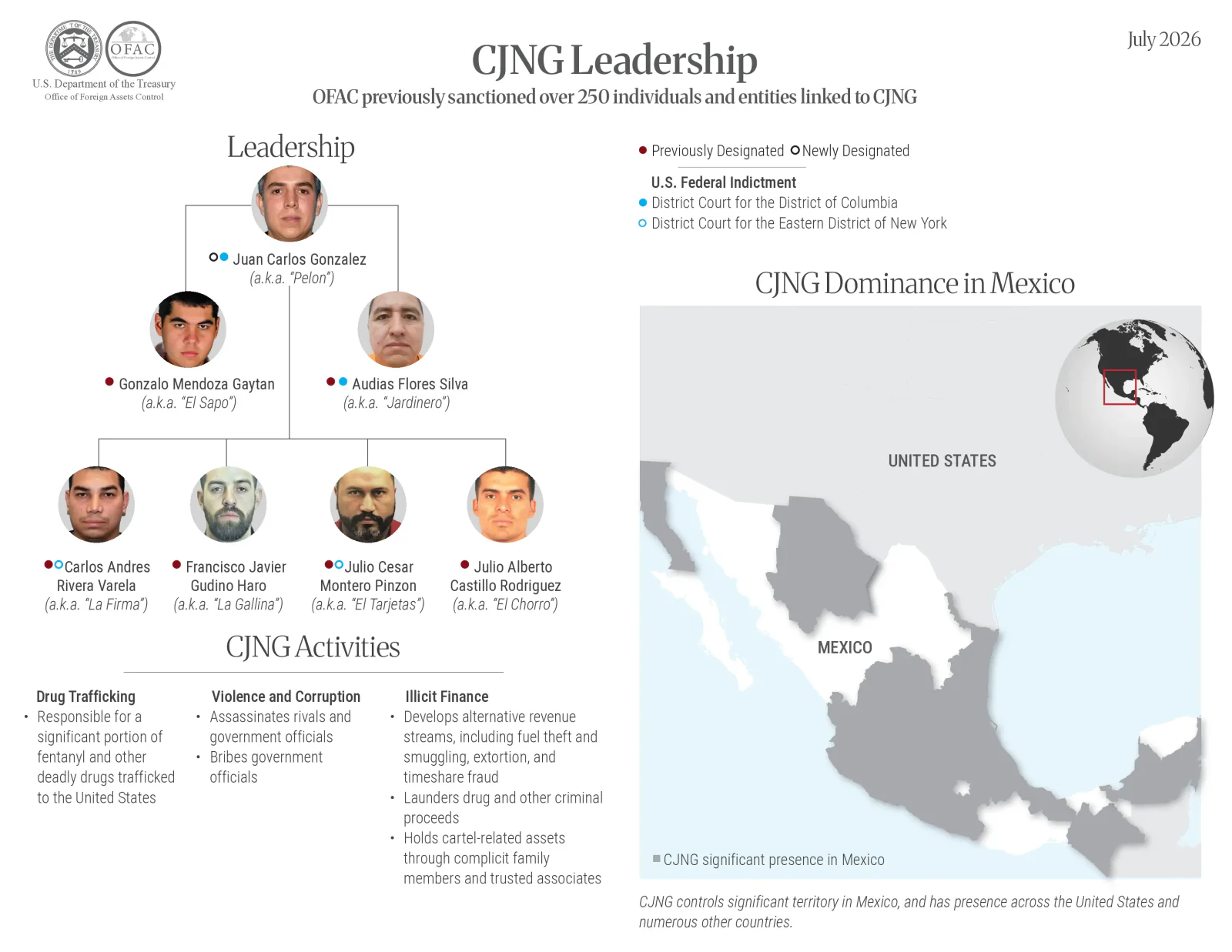
On July 23, 2026, the U.S. Department of the Treasury’s Office of Foreign Assets Control (OFAC) sanctioned more than 50 Mexican individuals and entities tied to Cartel de Jalisco Nueva Generacion (CJNG). Treasury called it the largest action it has ever taken against the cartel. The targets include the group’s new leader, dual Mexican-U.S. national Juan Carlos Gonzalez, known as “Pelon.” He took over after his stepfather and CJNG founder, Ruben Oseguera Cervantes, “El Mencho,” was killed in a Mexican government operation in February 2026.
In the press this reads as a cartel story. It is also a sanctions story, and the legal consequences arrive fast for anyone connected to the U.S. financial system. Banks, businesses with Mexican counterparties, and the family members and front companies pulled into the action all have something to worry about. CJNG also carries a second label that changes the math: it is a designated Foreign Terrorist Organization. That pushes the exposure past frozen accounts and into possible criminal liability. Below, we cover what the designations do, why the terrorist label sharpens the exposure, and the options if you have been caught in the net.
What OFAC Announced on July 23, 2026
The action names more than 50 individuals and entities across several Mexican states, reaching from cartel leadership down to the accountants, relatives, and shell companies that hold the money. OFAC issued the designations under two authorities at once: Executive Order 14059, which targets the international trafficking of illicit drugs, and Executive Order 13224, as amended, which targets terrorists and those who support them.
Treasury built the case through the Homeland Security Task Force, coordinating investigations run by the FBI, Homeland Security Investigations, and the Drug Enforcement Administration. It ran the action alongside Mexico’s financial intelligence unit, the Unidad de Inteligencia Financiera. OFAC called its method a “network-based approach”: hitting leadership, financiers, front persons, corrupt officials, and complicit family members at once rather than picking off names one at a time. Since April 2015, the agency has designated more than 250 individuals and entities linked to CJNG.
Why CJNG’s Terrorist Designation Raises the Legal Stakes
On February 20, 2025, the U.S. Department of State designated CJNG as both a Foreign Terrorist Organization (FTO) and a Specially Designated Global Terrorist. That means CJNG is not just an ordinary name on the SDN List, and that difference should drive any exposure analysis.
The distinction matters because of a federal criminal statute, 18 U.S.C. § 2339B, which makes it a crime to knowingly provide “material support or resources” to a designated FTO. The statute defines material support broadly to reach money, property, services, and more, and the penalties run up to 20 years in prison, or life if a death results. Ordinary OFAC sanctions violations are enforced primarily through civil penalties, often on a strict liability basis. A terrorist designation layers criminal exposure on top of that civil regime.
So a company that provides funds, goods, or services to CJNG or to a blocked person in its network is no longer looking only at a civil monetary penalty. It may face a federal material support prosecution. Designating this round under both the narcotics authority (E.O. 14059) and the counterterrorism authority (E.O. 13224) is no accident. Treasury is stacking the two regimes.
The Networks OFAC Targeted
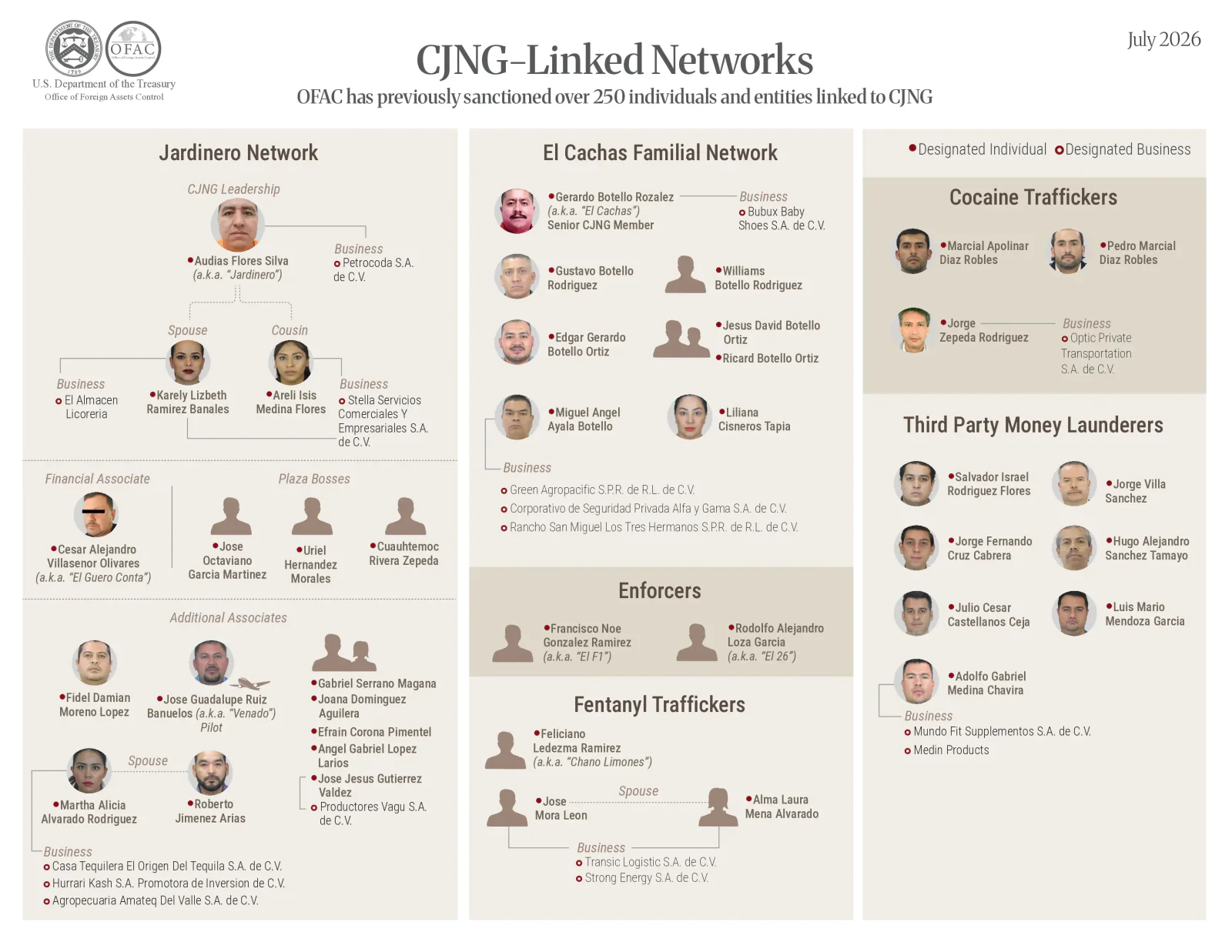
The names in the July 2026 action interlock. The main clusters below show how the cartel hides money in plain sight:
- Cartel leadership. New leader Juan Carlos Gonzalez (“Pelon”) is charged in a U.S. federal drug trafficking indictment in the District of Columbia, and the State Department is offering up to $5 million for information leading to his arrest or conviction. He joins previously designated leaders such as Audias Flores Silva (“Jardinero”).
- The Jardinero family network. Even after Mexican authorities arrested Jardinero in April 2026, his network kept running. OFAC designated relatives and subordinates who hold his assets through a web of businesses: a gas station company, a liquor store, a wholesale clothing company, a tequila producer, and a construction firm. It also named plaza bosses producing fentanyl, cocaine, and methamphetamine in clandestine labs.
- The “El Cachas” network. Senior member Gerardo Botello Rozalez (“El Cachas”) ran a cell alongside nephews and other relatives, some of whom became municipal police officers under a family member who directed public safety in their town. Linked companies include a private security firm licensed to carry firearms, a baby-shoe company, and tequila and agricultural businesses.
- Fentanyl trafficking and fuel theft. Several targets pair fentanyl trafficking with huachicol, the theft and smuggling of fuel that costs Mexico billions. OFAC named operatives along with the logistics and energy companies used to divert liquid fentanyl and steal gasoline.
- Cocaine trafficking and money laundering. OFAC targeted a cocaine network led by twin brothers from Guadalajara and their money broker, plus a professional money laundering network based in Zapopan and Guadalajara that OFAC says laundered tens of millions of dollars per year since at least 2023 by collecting bulk cash in U.S. cities and moving it back to Mexico.
Many of the targets of these designations are not obvious cartel figures. They are wives, cousins, sons, and “ostensibly legitimate” businesses: gas stations, liquor stores, tequila producers, even a baby-shoe company. OFAC listed them because leaders park their assets with relatives and front persons to keep those assets off the radar.
How the 50% Rule Sweeps In More Companies
Besides the new targets added by name to the SDN List, OFAC also noted that additional entities may be affected by these designations through the 50% Rule. Under the rule, any entity that one or more blocked persons own 50 percent or more of, directly or indirectly and individually or in the aggregate, is itself blocked, whether or not OFAC ever names it. That means these designations radiate outward from every named target to any other entities that they own 50% or more of.
The compliance takeaway is simple. Screening a counterparty’s name against the SDN List is not enough on its own to detect the presence of a blocked interest; you have to look through the name to the ownership behind it. That is the kind of exposure that sends businesses to OFAC compliance counseling before a problem surfaces.
What Happens When You Land on the SDN List
Once OFAC adds a person or company to the Specially Designated Nationals and Blocked Persons List (SDN List), several consequences hit at once:
- All property is blocked. Any property or interests in property that the designated person holds in the United States, or that a U.S. person possesses or controls, is frozen and must be reported to OFAC.
- The 50% Rule extends the block. Any entity owned 50 percent or more, individually or in the aggregate, by blocked persons is blocked automatically as well.
- U.S. persons cannot transact. Without a license or exemption, U.S. persons are barred from virtually all dealings with the blocked party, including providing funds, goods, or services.
- Strict liability applies. OFAC can impose civil penalties on a strict liability basis, meaning a company can be penalized even where it did not know it was dealing with a blocked party.
- Criminal exposure for terrorist-linked support. Because CJNG is an FTO, knowingly providing material support can trigger federal criminal liability under 18 U.S.C. § 2339B on top of civil sanctions penalties.
- Whistleblower incentives. FinCEN’s whistleblower program may reward those who report sanctions violations that lead to enforcement actions with penalties exceeding $1 million.
Secondary Sanctions and Foreign Bank Exposure
The reach does not stop at the U.S. border. Treasury warned that foreign financial institutions that knowingly conduct or facilitate significant transactions for the persons designated today risk secondary sanctions. OFAC can cut off their correspondent and payable-through accounts, restricting or ending their access to the U.S. financial system. For Mexican and international banks with any nexus to these networks, losing U.S. dollar clearing usually stings more than any single blocked account.
If You’ve Been Designated or Blocked: Getting Off the SDN List
OFAC’s press release spent nearly as much space on leaving the list as on joining it. The agency stressed that the goal of sanctions “is not to punish, but to bring about a positive change in behavior,” and pointed readers to its guidance on filing a petition for removal.
That process is SDN List removal, formally a petition for administrative reconsideration under 31 C.F.R. § 501.807. The designated party presents arguments and evidence showing either that the basis for the designation no longer exists, or that it was never sufficient in the first place. As of mid-2026, OFAC routes these petitions through its Reconsideration Portal.
For the family members and front-company owners caught in an action like this, the strongest delisting arguments usually turn on distance: that the person was swept in through an ownership tie or a family relationship, plays no operational role in the cartel, and has divested from or wound down the blocked business. If your funds or accounts are frozen, an unblocking application or a specific OFAC license may release the property or authorize otherwise prohibited transactions, such as legal fees or an orderly wind-down. A terrorist designation carries criminal weight as well as civil, so these matters often call for sanctions counsel and criminal defense counsel working together.
Frequently Asked Questions
What does it mean that CJNG is a Foreign Terrorist Organization and not just an SDN?
An SDN designation blocks a target’s property and bars U.S. persons from dealing with them, enforced mainly through civil penalties. A Foreign Terrorist Organization designation adds a criminal layer: under 18 U.S.C. § 2339B, knowingly providing material support or resources to an FTO is a federal crime carrying penalties up to 20 years, or life if a death results. CJNG holds both statuses, so dealing with the cartel or its network can bring civil and criminal exposure at the same time.
My relative or my company was named because of a business connection — what should I do now?
You have options. Many people land on the SDN List through the 50% Rule or a family relationship rather than any direct cartel role. The way off the list is a petition for administrative reconsideration, in which you present evidence that the basis for your designation does not apply or no longer exists. Given the stakes, talk to an OFAC sanctions attorney before you respond to OFAC or keep operating a blocked business.
Can a U.S. citizen like “Pelon” be sanctioned by OFAC?
Yes. OFAC can designate U.S. persons, and dual nationals are not exempt. Juan Carlos Gonzalez is a dual Mexican-U.S. national, and his designation blocks his property and interests in property in the United States just as it would for any other SDN. U.S. citizenship does not shield a person from sanctions, though it does raise distinct constitutional and procedural questions that an experienced sanctions attorney can address.
Talk to an OFAC Sanctions Attorney
The July 23, 2026 CJNG action shows how far a single OFAC designation can reach: from a cartel leader to his stepson’s relatives, from a Guadalajara money-laundering ring to a baby-shoe company held in a cousin’s name. If you, your business, or a counterparty has been designated, blocked under the 50% Rule, or frozen out of the U.S. financial system, the steps you take in the first few weeks matter.
Sanctions Law Center is a Washington, DC firm focused on OFAC sanctions. We handle SDN List removal petitions, unblocking applications, OFAC licenses, and compliance counseling for clients around the world. Contact us for a confidential case evaluation.
This page is for general informational purposes only and does not constitute legal advice. You should not act or rely on this information without seeking advice from qualified counsel about your specific facts.
On This Page
Recent Blog Posts
Do Sanctions Work? A Conversation on Iran and Beyond, August 13 in Brooklyn
Sanctions Law Center founder Mohsen Farshneshani speaks Aug 13 in Brooklyn on whether sanctions work, from Iran to elsewhere. RSVP for in person or livestream.
Exodus Movement Settles with OFAC for $3.1 Million Over Iran Sanctions Violations
Exodus Movement agreed to pay $3.1M to settle 254 apparent Iran sanctions violations. Learn what crypto and fintech companies need to know about OFAC compliance from this enforcement action.
My Funds Were Blocked Because of OFAC Sanctions – What Do I Need to Know to Get My Money Back?
Discover what it means when OFAC blocks your funds, who can unblock them, how to apply for an unblocking license, and why working with an OFAC sanctions lawyer is essential to recovering your money.